

When a Useful Adjustment Starts Feeling Like Personality
A lot of what people call personality did not begin as personality at all.
It began as problem solving.
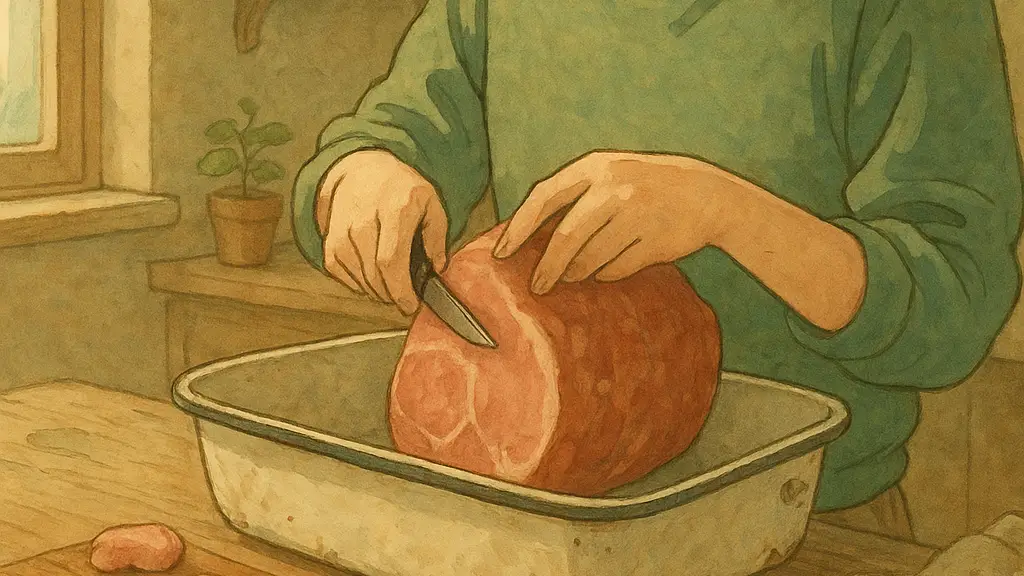
A family recipe moves from one kitchen to the next. Each time the ham goes into the oven, the ends get cut off first. No one argues about it. No one explains it. It is simply repeated until someone finally asks why, and the answer turns out to be plain: years ago, the pan was too small.
That is what makes the story stay with people. The original choice was reasonable. The part that becomes strange is not the choice itself, but the way it survives after the reason is gone.
Something similar happens inside a life.
A person learns to stay quiet in a house where speaking up creates tension. Another learns to expect little because wanting more feels dangerous. Someone becomes highly agreeable because it kept the peace. Someone else becomes hypervigilant because missing a cue once carried a cost. At first these are adjustments. They help a person fit the conditions around them.
Then the conditions change.
The adjustment stays.
And after enough years, it stops feeling like a strategy and starts sounding like self-description. This is just how I am. I overthink. I do not ask for much. I am not really a leader. I would rather stay in the background.
The pattern becomes personal.
The Reason Often Disappears Before the Habit Does
This is one of the quieter ways people get stuck.
Not because they are unwilling to grow. Not because they enjoy limitation. Usually it is because the original context has faded, but the body and mind kept the instructions.
That matters. Human beings do not only remember events. We also remember what helped us get through them. If shrinking yourself helped you stay connected, you may keep shrinking long after the threat of disconnection has passed. If reading the room carefully kept you safe, you may still do it in rooms that are not asking anything of you.
The nervous system is practical that way. It does not wait for a philosophical conclusion. It notices what reduced friction and stores it.
Over time, the storage becomes identity language. A sentence that once described a circumstance becomes a sentence that describes a self. That move is subtle, but it changes everything. A circumstance can be revisited. A self-definition feels final.
This is why certain patterns are so hard to challenge. They no longer feel like habits. They feel like truth.
Why the Question Can Feel Uncomfortable
Even a simple question can stir up more than people expect.
Why do I do it this way?
That question sounds innocent on paper. In real life, it can feel loaded. It can feel disloyal. It can feel as if you are questioning people who were doing their best. It can feel like stepping outside a set of rules that once organized the world.
For many people, inherited patterns are tied to belonging. They are not just behaviors. They are evidence of loyalty, competence, humility, or care. So when a person begins to examine them, the discomfort is not imaginary. Something real is being touched.
That is why reflection sometimes brings up guilt before it brings up clarity.
But asking why is not the same as mocking what came before. It is not the same as rejecting family, discipline, culture, or survival wisdom. It is a way of restoring context. It is a way of understanding what a behavior was built for, so you can see whether it still belongs in the shape of your current life.
Without that context, an old workaround can keep wearing the costume of wisdom.
Not Every Inherited Pattern Needs to Be Rejected
This is where people often get forced into a false choice.
Either keep everything exactly as it was, or tear it all down.
Most mature change does not work like that.
Some inherited rules carry real intelligence. Some forms of restraint are wise. Some habits of care, structure, and discipline are worth keeping. The point is not to become suspicious of everything you were taught. The point is to become capable of distinguishing between what is alive and what is outdated.
A living principle can usually explain itself in the present. It still fits the conditions. It still serves something real. An old adaptation often cannot do that. It survives because it is familiar, not because it is still needed.
That is an important difference.
You do not need rebellion to notice it. You need honesty. You need enough steadiness to ask whether the old container is still the size of your life.
If the answer is yes, then the pattern may still have a place. If the answer is no, then repeating it automatically is not loyalty. It is just inertia.
The Clues Are Usually Small Before They Are Obvious
Most people do not wake up one morning with a dramatic realization. It tends to arrive more quietly than that.
You notice that a normal request feels strangely hard to make. You apologize before saying something simple. You prepare for conflict in a room that feels mostly safe. You downplay your own preference even when no one has challenged it. You feel a familiar contraction, but the circumstances around you do not fully explain it.
Maybe you are in a meeting and have a useful point to add. You can feel it clearly enough. Then your chest tightens, you tell yourself someone else has probably said it better, and the moment passes. A few minutes later, another person says nearly the same thing and the room receives it without trouble.
That kind of moment can sting, but it can also reveal something.
Not that you are flawed. Not that you failed a confidence test. Only that an old instruction may have shown up before you had the chance to choose.
These small mismatches are often the doorway. They suggest that the pattern may not be an eternal feature of your nature. It may be an old accommodation arriving on time for a problem that is no longer here.
Choice Begins Smaller Than Most People Expect
Once you see a pattern this way, the next step is usually more modest than people imagine.
You do not have to reinvent yourself.
You do not have to confront everyone who helped shape you. You do not have to prove anything dramatic. The useful shift is smaller and more respectful than that. It is the shift from unconscious repetition to conscious examination.
What was this helping me do?
What did it protect?
Does that condition still exist here, now?
Those questions do not force a conclusion. They create space. They let you see whether you are responding to your present life or to a past limitation that still has a strong voice.
Sometimes the answer will be that the pattern still makes sense. Sometimes it will not. Either way, you become more accurate. And accuracy is gentler than self-judgment. It does not shame the adaptation for existing. It simply checks whether the tool still matches the task.
That is how change becomes workable. Not by declaring war on yourself, but by updating the map.
What You May No Longer Need to Cut Away
There is a particular relief in realizing that something long treated as identity may have been context all along.
Maybe you are not inherently indecisive. Maybe you learned that choosing wrong carried too much risk, so hesitation became safer. Maybe you are not naturally invisible. Maybe visibility once created exposure you were not ready for. Maybe you are not doomed to over-accommodate. Maybe accommodation was rewarded so consistently that it became your default posture.
None of that makes the pattern silly.
It makes it understandable.
And once something becomes understandable, it becomes easier to meet without contempt. You can thank it for what it protected. You can also notice, with some honesty, when it is asking you to keep discarding parts of yourself for a container that no longer exists.
That is the deeper question beneath the old-pan story. Not what should be rejected. Not who was wrong. Just this:
What are you still removing in order to fit a limit that may already be gone?
If that question stays with you, let it stay gently. The next useful move is not harsher self-correction. It is a little more curiosity the next time an old pattern appears, especially in the moments when you are tempted to call it who you are.
What to do next
Start with E.M.O.
Start with a guided nervous-system support experience.
Take the EFI
Get emotional clarity and identify your current regulation pattern.
1 on 1 Session
Work directly with guided support when you want faster progress.
