

When Your Mind Reopens the Scene at Night
There is a particular kind of tired that does not lead to sleep.
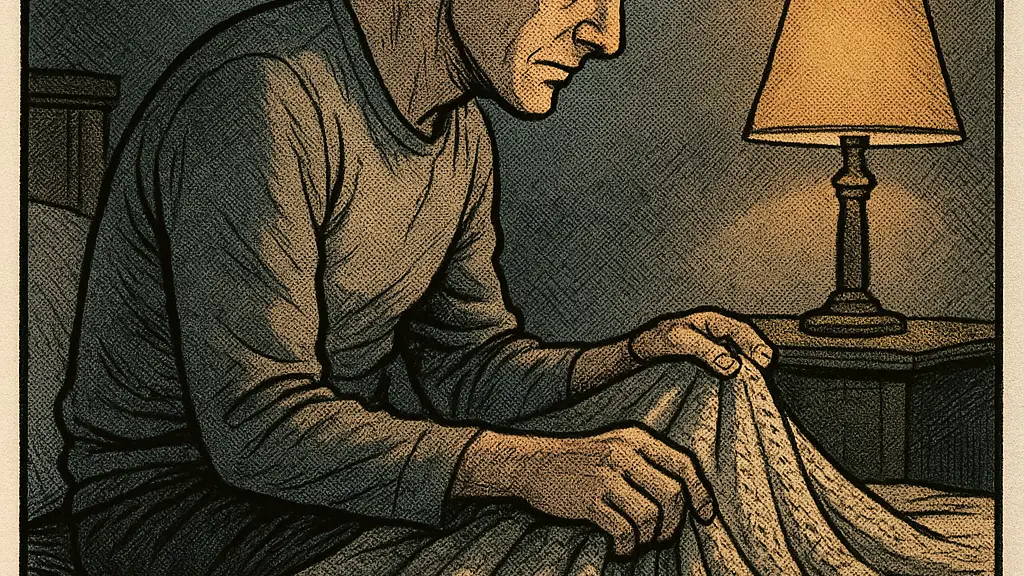
You are in bed. The room is quiet. The conversation is over. Nothing else is happening. And still your mind keeps returning to one small unresolved exchange as if it missed something important the first ten times through.
Maybe it was a pause that felt off. A text that landed flatter than you meant. A look on someone's face that now seems harder to read than it did in the moment. The details are often ordinary. That is part of what makes the whole thing so confusing. It was not a catastrophe. It was not even necessarily a conflict. But your body did not file it as finished.
So the mind keeps reopening the scene.
It tries a different interpretation. Rehearses a cleaner sentence. Scans for what the other person might have meant. Projects into tomorrow and starts preparing for what might be required next. From the outside, this can look like simple overthinking. From the inside, it feels more urgent than that. It feels like if you could just think clearly enough, the unsettled feeling would release and rest would finally become allowed.
That feeling makes sense.
The mind is rarely looping at random. More often, it has been handed a job.
The Thought Loop Is Usually Trying to Protect You
When the body still reads uncertainty as active threat, thought gets recruited to solve it.
That is why the loop often has such a specific flavor. It is not just repeating the exchange for no reason. It is trying to prevent something. Prevent embarrassment. Prevent conflict. Prevent being caught unprepared. Prevent the future from arriving too fast.
This is a difficult job for thought to do well, especially at night.
Thought can review the past, imagine the future, and generate possible responses. What it cannot do is create full safety around something that has not happened yet. It cannot guarantee that another person will explain themselves. It cannot guarantee that tomorrow's conversation will go smoothly. It cannot guarantee that you will never feel exposed, misunderstood, or late to what matters.
But if the body believes certainty is required before it can stand down, the mind will keep working anyway.
That is why midnight thinking often feels both sincere and impossible. The system is trying to protect you with the only tool it has left online. Not because it is broken. Because it is overassigned.
This matters, because the way you relate to the loop changes what happens next. If you assume the thought itself is the enemy, you usually move into an internal fight. You try to suppress it, out-argue it, distract from it, shame it, or replace it with something more reasonable. Sometimes that works briefly. Often it adds another layer of strain. Now you are not only activated by the exchange. You are also at war with your own attempt to stay safe.
A Better Question Than "How Do I Stop Thinking?"
There is a gentler and more accurate question available.
Instead of asking, "How do I shut this thought off?" ask, "What safety job does this thought think it has?"
That question does something important. It shifts the loop from enemy to information.
Now you are no longer demanding that the mind go silent before it has been understood. You are listening for the logic underneath the repetition. Usually the answer appears quickly once you ask plainly enough.
This thought is trying to make sure I am not embarrassed tomorrow.
This thought is trying to prepare me for a hard conversation.
This thought is trying to make sure I do not miss a signal.
This thought is trying to keep me from being blindsided again.
Once the job becomes visible, the urgency often softens a little. Not because the situation is resolved, but because the loop is no longer vague. It is legible. You can feel the difference between a mind that seems chaotic and a mind that is anxiously trying to perform a protective role it cannot complete.
That recognition is not the end of the process. But it is the turn.
You stop spending the night trying to win against the thought. You begin asking what the system is trying to accomplish, and whether there is a more proportionate way to help it.
What Actually Helps in That Moment
If thought has been assigned a safety job, the next step is not to think harder. It is to reduce the load on the system.
That usually means three things.
First, lower the body's sense of immediate threat. Not by launching into a full routine or trying to perfect your state, but by making the environment less dependent on mental effort. Feel your feet under the blanket. Put the phone face down. Let one exhale run a little longer than the inhale. Notice the contact points that tell your body where you are right now. Nothing dramatic. Just enough to remind the system that the room is not the conversation.
Second, name the open loop in plain language. This matters because an unnamed loop tends to stay ambient and global. A named loop becomes smaller. You might say, "That exchange feels unfinished, and I do not know what it means yet." Or, "I am worried I came across badly, and I cannot resolve that tonight." The point is not to sound polished. The point is accuracy.
Third, give the loop one honest checkpoint outside the mind.
Not a promise to solve your whole life tomorrow. Not a vague reassurance you do not believe. One actual checkpoint. "I will look at this after coffee." "If it still feels important in the morning, I will write one clarifying text." "I will decide tomorrow whether this needs a conversation or whether my body is enlarging it because I am tired."
This is often where the system begins to loosen. The mind does not have to hold the task all night if it trusts there is a place for the task to go.
And if the loop comes back, that does not mean the process failed.
A returning thought may simply be the body checking whether the job is still assigned to it. You do not have to restart the whole emergency just because the thought knocks again. You can recognize it without obeying it: "Oh, you are back. I see you. We still cannot solve this tonight."
That is a different relationship with the loop. The goal is not to eliminate every return of the thought. The goal is to make each return less commanding, so the loop becomes information instead of proof that you are back at the beginning.
Rest Does Not Need Total Resolution
One of the hardest truths for conscientious people is that rest often has to happen before certainty.
Not after every social thread is tied up. Not after every possible misunderstanding has been mentally mapped. Not after the future feels fully managed.
Before that.
This can feel deeply counterintuitive if your nervous system learned that vigilance is what keeps life from getting messy. But the loop you are in at night is usually not evidence that more analysis is needed. It is evidence that the body has not yet been convinced it can pause without becoming unsafe.
That is why the shift is so modest and so powerful. You are not trying to become detached. You are not pretending not to care. You are not minimizing the exchange. You are simply refusing to let midnight thinking carry a responsibility that belongs to tomorrow.
A small scene can help make this concrete. Someone turns onto their side for the fifth time, reaches for the phone, then stops. They place it facedown on the nightstand and say quietly, "My mind thinks it is keeping me prepared." They jot one line on a note, "Reply after coffee if it still matters," and feel the mattress again under the weight of their legs. The situation is still unfinished. But the night no longer has to serve as the final court of appeal.
That is often enough.
Not enough to create perfect calm. Not enough to guarantee easy sleep. Enough to stop feeding the loop with the belief that safety depends on solving everything now.
If this pattern is familiar, the next useful step is usually simple, not grand. Once you can see the safety job your thoughts keep taking on, it helps to have a brief way to settle the body's threat load without turning that into another performance. Sometimes five steady minutes of nervous system repair is more useful than another hour of analysis. Not because the conversation never mattered, but because your mind was never meant to carry it alone through the night.
What to do next
Start with E.M.O.
Start with a guided nervous-system support experience.
Take the EFI
Get emotional clarity and identify your current regulation pattern.
1 on 1 Session
Work directly with guided support when you want faster progress.
