

The Relief Is Real
AI is becoming ordinary at work because it does something genuinely helpful. It can turn rough notes into a clean draft, summarize a dense meeting, organize research, and remove a layer of repetitive admin that used to eat an afternoon. Recent reporting from the Federal Reserve’s 2026 Report on Employer Firms, the U.S. Chamber Foundation, and Hiring Our Heroes all describe a similar pattern: owners and workers are using AI in practical ways to save time, improve work quality, and handle routine complexity, while still managing trust, skills, privacy, and responsibility. That matters. It means the appeal is not imaginary. For many people, AI is not a novelty now. It is a real source of relief inside a crowded workday.*
The Unsent Email Still Sits There
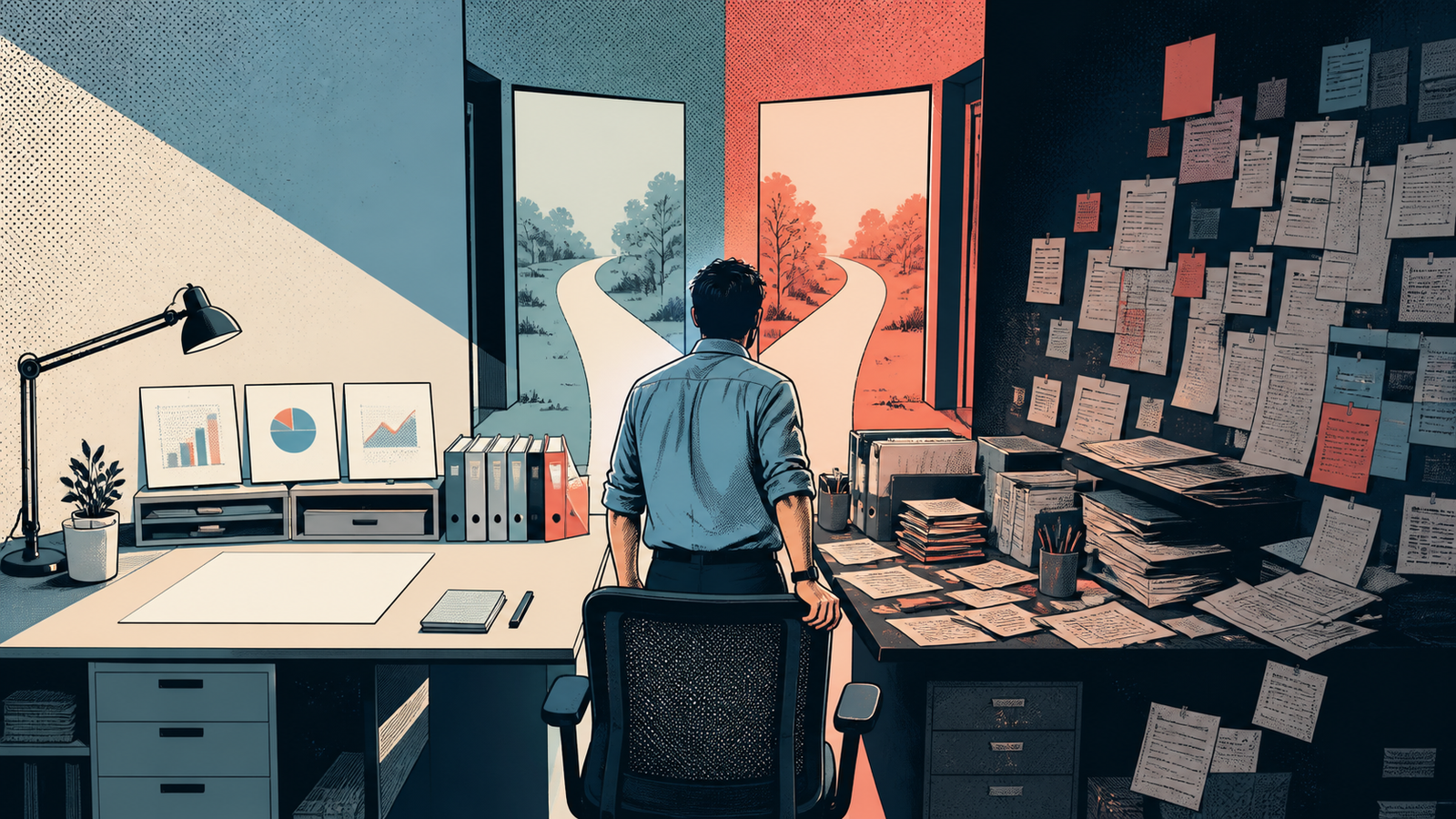
It is 5:40 p.m. and the desk finally looks under control. The summary is written, the proposal sounds sharper, and the email draft has been revised into three polished versions with a neat list of pros and cons. For a moment, the order feels like progress. Then the same question returns: what boundary are you actually setting, what offer are you actually making, or what truth are you actually willing to send?
That is the moment worth noticing.
The discomfort was never only about wording. It was about choosing. AI may have cleaned up the visible mess, but the real work can still be sitting quietly in the middle of the room, untouched.
Some Work Is Hard for Different Reasons
It can help to notice that different kinds of hard work ask for different kinds of help.
Some work is hard because it is tedious, and automation can be a real relief. Some work is hard because there is too much information and no clear structure, and AI can help sort it, condense it, and give you a cleaner field to look at. But some work is hard because no amount of sorting can decide what matters most. Someone still has to say no to one path, accept the cost of another, name a limit, or move before certainty arrives.
That kind of difficulty is not a flaw in your system. It is part of being responsible for real work.
If a well-organized draft still leaves you unsettled, there is nothing strange or shameful about that. It may simply mean the work has shifted categories. You are no longer dealing with friction. You are dealing with judgment.
When More Output Creates More Distance
This is where AI can become quietly seductive.
Picture a consultant with a proposal that keeps feeling off. She asks AI for ten versions: warmer, firmer, shorter, more persuasive. All ten are usable. Then she realizes the problem is not the wording. She has to decide whether to name the scope clearly, raise the price to match the work, or walk away from an engagement that does not fit. Another proposal version cannot make that choice for her.
Most of us have done some version of this: kept refining the material because the decision underneath it felt harder to face.
None of this means the output is bad. It means output and movement are not the same thing.
Sometimes more material helps us see. Sometimes it gives us one more place to delay contact with the choice. The polished output can lower the discomfort that would otherwise tell us something unresolved is still waiting. That is one reason AI can make avoidance look so productive. The work appears to be moving, and in a narrow sense it is. Yet the consequential decision can remain exactly where it started.
The Research Supports the Tool, Not the Escape
It is worth being precise here, especially because loose claims help no one.
Current public reporting supports the idea that AI can improve speed, quality, planning, and administrative capacity for many small businesses and knowledge workers. It also supports the idea that adoption comes with real concerns about readiness, trust, privacy, and execution. Those are grounded, practical findings. They fit what many people are already seeing in ordinary work.
What that research does not prove is an inner emotional mechanism. It does not prove that AI is making you avoid your life. It does not prove that every long prompt, workflow, or revision loop is a defense. That part is better held as a self-observation question, not a public certainty.
Are you using the tool to reduce friction around a real choice, or to postpone contact with the choice itself?
That question is intellectually cleaner. It respects the evidence. It also respects the reader.
The Best Question to Ask After an AI Pass
A lot of confusion can clear when we stop asking only, "Is this output good?" and start asking, "What decision is still mine?"
That question does not solve the choice, but it puts judgment back in the right place.
A second question can follow: did this session make the next human move clearer, smaller, and more actionable, or did it create more material between me and the move? If the move is clearer, the tool did its job. If it is not, the page may be finished while the decision is not.
From there, the decision may become simple enough to say out loud: choose the offer, send the boundary email, cancel the process that does not need to continue, or ask for the conversation you have been trying to optimize your way around. The aim is not forced certainty. It is enough clarity for one real step to come into focus.
The point is not to become suspicious of every helpful tool. The point is to keep the tool in a support role. AI can widen the field, but at some point the field has to narrow into a path.
Judgment Is Part of the Value You Bring
It is easy to hope that if the system were refined enough, the right choice would reveal itself without cost. No tension. No exposure. No responsibility.
But serious work rarely unfolds that neatly.
Context matters. Values matter. Timing matters. Other people matter. Sometimes the real challenge is not producing a better set of options. It is being willing to bear the uncertainty of choosing one. That is why judgment is not the inefficient leftover after automation. It is one of the highest-value human contributions still in the room.
AI can support judgment. It can challenge assumptions, surface possibilities, and remove unnecessary drag. It can help you prepare. It cannot carry responsibility for you. It cannot know what promise you are willing to make, what compromise you can live with, what risk belongs to you, or what kind of person you are trying to be while you work.
Those are not technical leftovers. They are the human center of the task.
Let a Cleaner Desk Lead to a Real Move
A healthy relationship with AI is not anti-technology. It is simply clear about the division of labor.
The tool can handle repetition, first-pass drafting, information load, and the mechanical drag that drains attention. It can widen the field when more options would genuinely help. The capacity it returns can then go back to the place only a person can occupy, where context, care, accountability, and choice meet. Sustainable prosperity depends less on maximum output than on preserving enough human capacity to choose well.
If the desk is cleaner but the decision is still untouched, that is useful information. It means the next move is probably not another prompt. It is a smaller act of contact with reality. It is the moment where productive motion stops being enough, and honest movement begins.
That does not mean the tool failed. It may simply mean the tool has brought you as far as it can.
The Next Step May Be Smaller Than You Expect
The next honest move is often not dramatic. It may be one sentence you stop polishing and send, one option you cross off, one meeting you decide not to schedule, or one direct admission that the issue is not lack of ideas but reluctance to choose.
That kind of step may feel smaller than another hour of productive AI work, but it is usually closer to real momentum.
And if even that small step feels strangely hard, that matters too. Sometimes the issue is not the quality of the output. Sometimes the issue is the state you are in while trying to decide. Stress can make another version feel safer than a real move. Pressure can make more analysis feel kinder than contact. If that is what is happening, the next useful question may not be about AI at all. It may be about whether stress is quietly shaping the decision you think you are trying to make.
*Sources and further reading: Federal Reserve’s 2026 Report on Employer Firms, U.S. Chamber Foundation’s “What Small Business Owners Say AI Is Actually Doing at Work”, and Hiring Our Heroes’ “AI in Action” whitepaper.
What to do next
Start with E.M.O.
Start with a guided nervous-system support experience.
Take the EFI
Get emotional clarity and identify your current regulation pattern.
1 on 1 Session
Work directly with guided support when you want faster progress.
