

Regulating in Culture
7 min read
This is a reflection on fear, urgency, and moral narrowing. It is not a claim that every danger is imagined, or that pausing removes the need for boundaries and protective action.
Before You Read
Series Note: Regulating in Culture
This series uses familiar cultural moments as a way to notice what activation does to perception, and what a little more regulation can make reachable in ordinary life.
The Scene That Clings to You
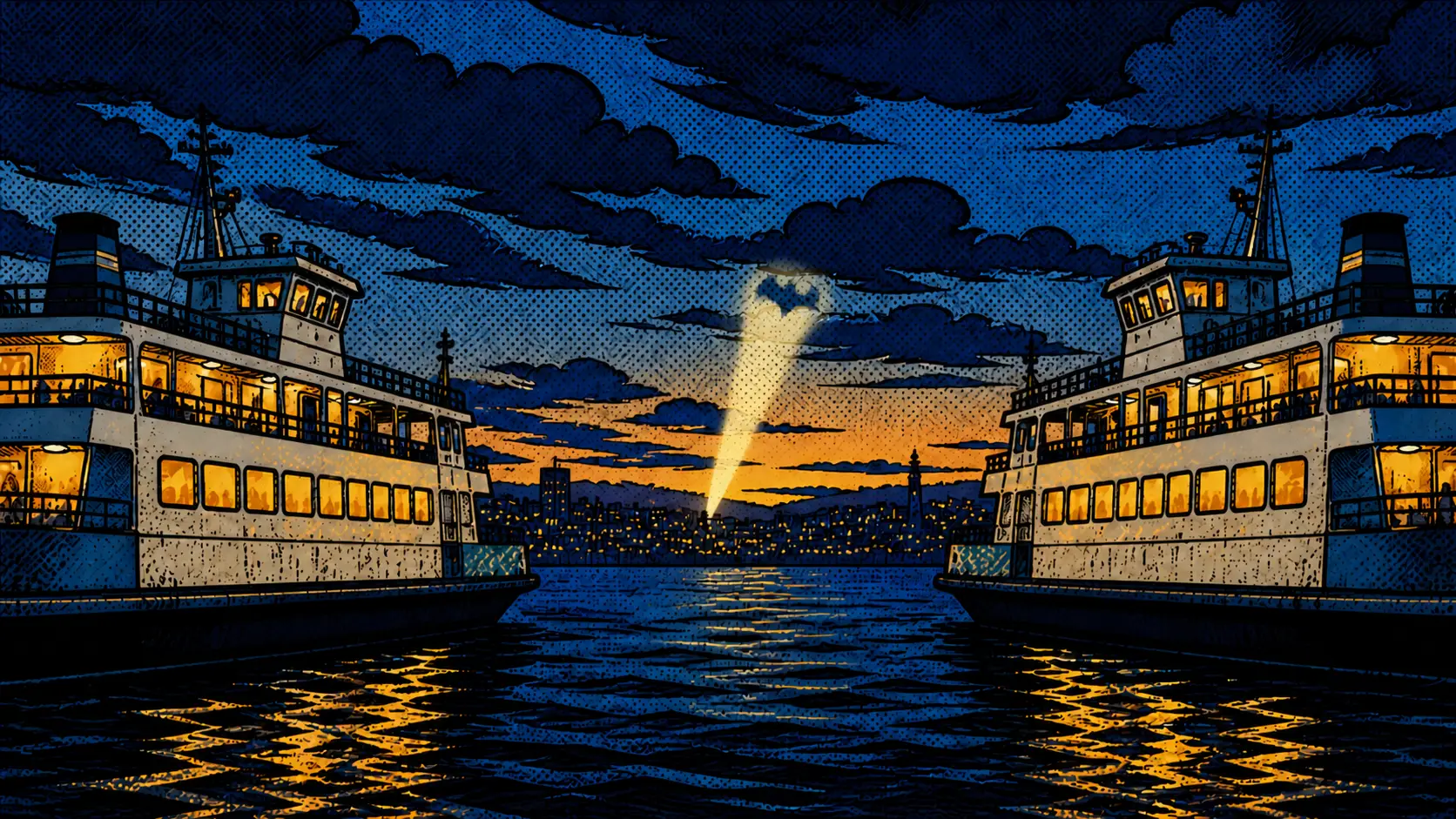
The ferry experiment in The Dark Knight stays with people for a reason. Two groups are placed under pressure, given partial information, and handed a brutal story about what survival requires. The story is simple enough to feel convincing in the moment: if you do not act first, you may be destroyed by people you have never met.
That is what makes the scene more unsettling than a standard moral test. It does not only ask whether people are good or bad. It shows how quickly fear can reorganize what looks reasonable. Under enough urgency, trust starts to look childish. Imagination starts to look irresponsible. The possibility of another path begins to feel like a luxury no one can afford.
The terror is not only in the threat. It is in how small the world becomes.
The More Disturbing Question
A lot of people talk about the scene as if the main issue is whether someone will press the button. But the deeper question arrives a little earlier than that.
The real fork is whether fear gets to decide who counts before anyone has time to recognize another person’s vulnerability.
That shift matters. Once fear is authorized to make that decision, harm starts to look less like cruelty and more like duty. The other group stops feeling human in any emotionally relevant way. They become a problem to solve, a risk to neutralize, an obstacle between you and safety.
That is why hesitation matters so much in the scene. So does conversation. So does refusal. None of these things erase danger. They do something smaller and more important. They interrupt fear’s attempt to become the only voice allowed to define reality.
When Fear Starts Calling It Responsibility
Fear is not foolish. Often it is the first system in us to notice that something important is at stake. It can detect danger, exposure, betrayal, instability, and genuine risk long before our thoughts become coherent enough to explain what is happening.
The problem begins when fear stops being a signal and becomes the whole frame.
Once that happens, perception compresses. Time feels shorter than it is. Options feel fewer than they are. The future narrows into one harsh corridor and then presents that corridor as wisdom. In that state, preemptive harm can feel responsible. Withdrawal can feel mature. Certainty can feel like integrity.
This is not because a person has secretly become monstrous. It is because activation changes what becomes visible. First the body braces. Then the mind narrows. Then the first protective interpretation starts sounding like the entire truth.
That sequence shows up in public crises, in families, in workplaces, and in private relationships. The scale changes. The mechanism does not.
How It Happens in Ordinary Life
You do not need a ferry, a villain, or a dramatic countdown for this pattern to become familiar. It can happen under a kitchen light with a phone in your hand.
A text lands late at night, and your body reacts before the meaning is fully clear. Your chest tightens. Your jaw sets. In seconds, the mind produces a story about what must happen next: send the sharp reply, pull away, accuse, protect yourself, end it before you can be hurt. The fear may be pointing to something real, but it is also shrinking the field of vision while it speaks.
That is one reason emotionally intelligent people can still feel trapped inside reactions they can name. Recognition is not always enough. You may know fear is active and still be unable to feel any live alternative from inside it.
Why Small Pauses Matter More Than Big Speeches
In moments like that, what helps is rarely a perfect insight. It is usually something humbler.
A fuller breath. Both feet on the floor. Cold water on the wrists. A few rounds of tapping. Thirty seconds of not sending the message. The steady presence of someone who can say, “Stay here for a second before you decide.”
These practices do not make danger unreal. They do not guarantee that the other person is safe, that the situation is harmless, or that the right next step will become obvious on command. Their value is more modest than that, and more reliable. They loosen fear’s grip on perception just enough for context to return.
When that happens, something important becomes possible. Another person’s vulnerability becomes visible again. Your own fear stops sounding identical to truth. The move you make next may still be firm. It may still involve a boundary, a refusal, or a hard conversation. But it no longer has to come from the most compressed version of reality.
Regulation Is Not Denial
This distinction matters because many people resist pausing for a good reason. They are afraid that any softening will make them naive, undefended, or slow at the exact moment when they most need clarity.
Sometimes that fear has history behind it. There are people who were taught, directly or indirectly, that hesitation is dangerous and tenderness is costly. There are environments where speed, suspicion, and preemptive control are rewarded. There are real situations where the stakes are not imaginary.
So it is important to say this plainly: regulation is not the same as pretending everything is fine.
The point is not to become less discerning. The point is to become less compressed. A regulated state does not force optimism onto reality. It simply gives reality more room than fear does. That room is where discernment lives. It is where proportion lives. It is where another human being can remain real, even when you still need to protect yourself.
The Conditions That Help Us Stay Human
Individual practices matter, but shared conditions matter too. A person can breathe, ground, or tap. A family, team, or community can also decide whether fear will be given unchecked authority.
Shared information helps. So do slower processes around irreversible choices. So do repair expectations that do not treat every rupture as proof of permanent threat. So does any culture that makes room for complexity before forcing people into camps of innocent and disposable.
This is part of why the ferry scene feels larger than one fictional dilemma. It reveals how easily human beings can be pushed into a story where someone else’s destruction starts to feel like the price of safety. It also reveals that even under pressure, there can be a thin but meaningful gap between fear and action.
That gap is not weakness. It is civilization at a nervous-system level.
What Becomes Possible After the World Widens
A humane future does not depend on people becoming fearless. It depends on enough inner practice and enough shared structure that fear does not get to rule alone.
That future is built in small places first. In the breath before the accusation. In the moment before the reply is sent. In the meeting where people ask for one more piece of context before choosing the most punishing interpretation. In the relationship where both people learn that urgency does not always deserve immediate obedience.
None of this guarantees a good ending. Some dangers are real. Some relationships are not repairable. Some choices remain hard even after the nervous system settles.
But when fear is no longer the only voice authorized to decide who counts, the world changes shape. More options come into view. More humanity survives the moment. And what seemed unrealistic begins to look more like something unpracticed.
What to do next
Support options
Recommended next step
Start with E.M.O.
Start with a guided nervous-system support experience.
Talk to E.M.O.Take the EFI
Get emotional clarity and identify your current regulation pattern.
Take the EFI1 on 1 Session
Work directly with guided support when you want faster progress.
Book a session