

Mentor’s Corner
7 min read
A question I hear often in mentoring sounds like this:
- "Why would I write this much if I would never document like this in real practice?"
- "Am I supposed to write the whole session?"
- "How does spending more time on notes actually make me a better practitioner?"
That is one of the most important questions in training, because it goes to the heart of how a practitioner learns to think clearly when the work gets more complex.
First Clarification: The Targeted Section Is Not the Whole Session
No, you are not being asked to write out every turn, every pivot, every emotional beat, and every technique from a full session.
The targeted section is not meant to be a transcript.
It is meant to isolate the clearest stretch of process where something important can actually be seen.
That is why the "best fifteen minutes" frame matters.
Not because the rest of the session does not matter.
And not because your mentor only wants the easiest part to review.
But because once you try to include everything, the logic of the work often disappears inside the volume of the story.
Sequence gets muddy.
The key decision point gets buried.
The real shift blends together with five other things that also happened.
And then what you are left with is a long recap that may be sincere, but is much harder to learn from.
What Session Notes Are Actually For
This is the part I want to put in the center:
Session notes are not primarily for your mentor.
They are primarily for you.
They are for the practitioner who is still learning how to make invisible process visible.
They are for your future self, who will need to look back and understand not only what happened, but how you thought, what you noticed, what you chose, and why.
When a session goes well, it is easy to assume you will remember how you got there.
Usually you will not.
You may remember the emotional tone.
You may remember the relief.
You may remember that something important happened.
But the exact trail often fades quickly:
- what target you chose first
- what language carried the charge
- what made you stay there
- what told you it was time to shift
- what changed after each round
That trail matters.
Because later, when a session is less straightforward, that is the trail you will need.
Why Objectives Belong at the Top
One of the most useful habits in mentoring is deciding before the session which objectives you are trying to demonstrate.
Not all seven.
Not all four or five depending on which module you are in.
Usually two or three.
That choice does something very important.
It narrows your attention.
It tells your mind what to look for.
It helps you distinguish between:
- what happened in the session
- what matters for this write-up
If you already know that this note is going to focus on specific events and aspects, testing, and exact words, then your write-up no longer has to chase every interesting thing that occurred.
It can stay oriented.
You are not all the way around Jack's barn trying to prove that you did everything.
You are showing where, in this session, these particular objectives became visible.
That is cleaner for the note.
More importantly, it is cleaner for your own mind.
What the Best Fifteen Minutes Should Actually Show
A strong targeted section usually makes a few things easy to follow.
It shows:
- what you chose to focus on
- what made that the right place to begin
- what exact words or aspects carried the charge
- what intervention you used
- what shifted after that
- what you decided to do next
That is the real point.
Not a performance of comprehensiveness.
A visible decision trail.
If someone reads your note and can say, "I can see why you went there first, what happened when you did, and why you changed course after that," then the note is doing its job.
If, instead, the note mostly communicates that many things happened and you were thoughtful throughout, that may be true, but it is less teachable.
And when something becomes less teachable, it also becomes less adjustable.
Why This Matters When the Front Door Is Locked
This is where detailed notes become much more than an assignment.
In early sessions, sometimes the obvious route works.
You find the target.
You track the charge.
You tap.
The system responds.
Great.
But later, you will work with clients who are more defended, more complex, more layered, or simply less accessible in the usual way.
The front door will be locked.
And when that happens, you will need something better than a vague memory that says, "I think I usually do something like this."
You will need to know:
- where the sequence actually stalled
- whether the target was too broad
- whether the aspect was too diffuse
- whether the pacing widened too early
- whether you lost the thread when the client shifted scenes
- whether the intervention was fine but the rationale was off
That is what session notes help reveal.
They let you inspect the bottleneck.
They let you see where the route broke down.
And once you can see that, you can reroute.
Maybe not through the front door.
Maybe through a side entrance, a back door, a window, or the crawlspace.
But you cannot reroute clearly if your original process was never clear enough to inspect.
That is why this matters.
A Practical Way to Write Notes Without Getting Lost
If writing notes has started to feel sprawling or punishing, the answer is usually not to abandon structure.
It is to use structure more deliberately.
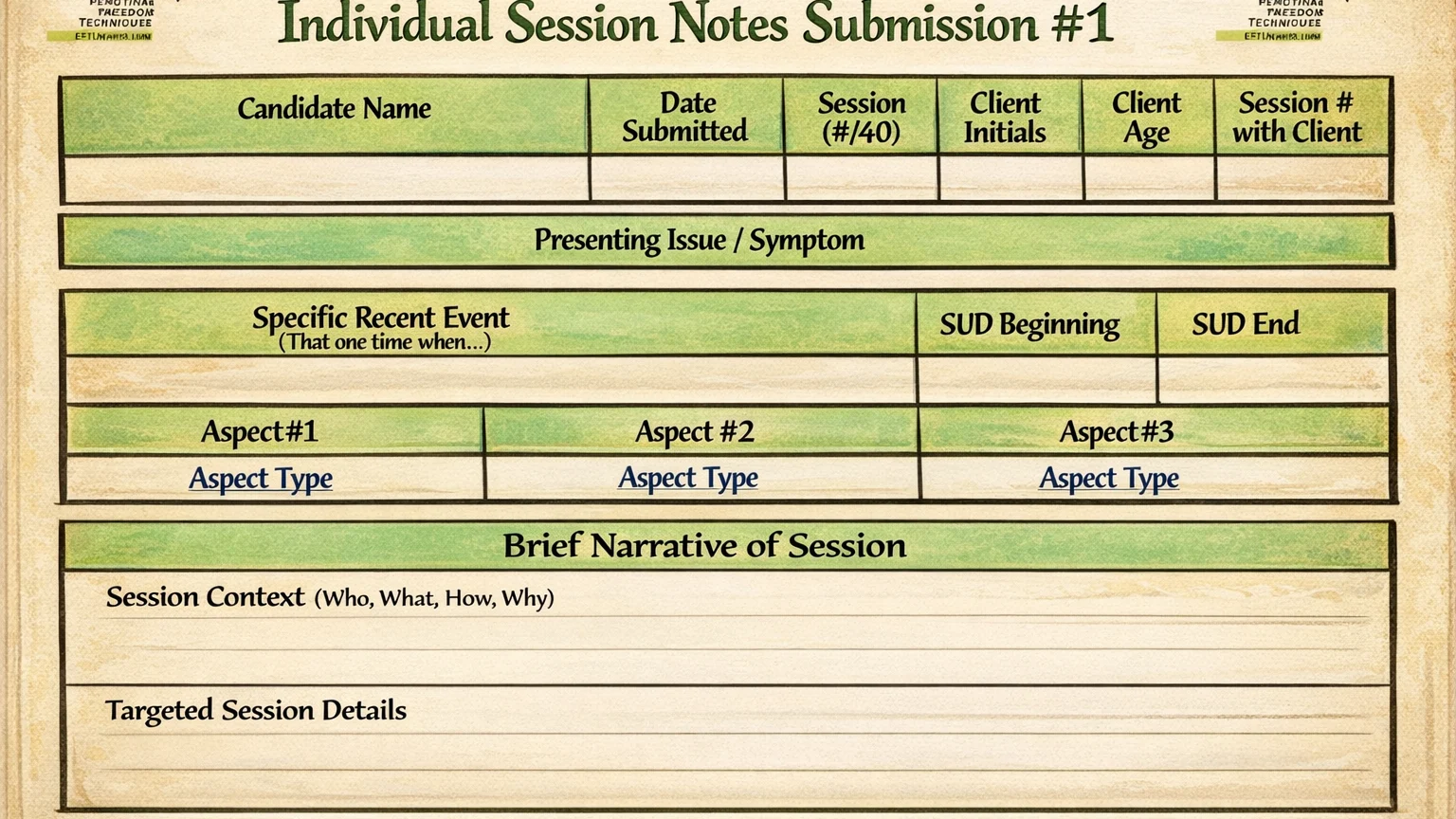
A simple sequence that often helps is:
- Choose two or three objectives before the session.
- Put those objectives at the top of the template.
- Write a short general context for who the client is and what the session was about.
- Use the targeted section to show the clearest fifteen minutes where those objectives were actually in play.
- In that section, track the sequence: target, charge, intervention, shift, next move.
That keeps the note from turning into either:
- a complete play-by-play
or
- a polished abstraction that never shows what actually happened.
You do not need to write everything.
You need to write the part that makes your process visible.
The Hidden Gain
Many mentees think session notes are mainly about meeting the program's requirements.
That is the surface layer.
The deeper layer is that they train a practitioner to observe their own work with enough clarity to refine it.
Good notes help you:
- catch drift earlier
- see what made a round effective
- notice where your thinking got fuzzy
- identify what you assumed without naming
- adjust without collapsing into self-criticism
That is a serious clinical skill.
Because in real practice, the question is not only, "Did this session help?"
It is also, "If this stops helping, will I know what to change?"
That answer depends a lot on whether your thinking has ever been concretized enough to examine.
Closing Reflection
If session notes have felt tedious, I understand.
If they have felt overly structured, I understand that too.
Try this reframe:
The point is not to prove that a session happened.
The point is to build a practitioner mind that can slow itself down, inspect what it did, find the bottleneck, and choose a better route when things get complicated.
That is why the best fifteen minutes matter more than the whole session.
Not because less happened there.
But because that is where your process becomes visible enough to trust, study, and improve.
What to do next
Continue Reading
Start with E.M.O.
Start with a guided nervous-system support experience.
Take the EFI
Get emotional clarity and identify your current regulation pattern.
1 on 1 Session
Work directly with guided support when you want faster progress.
