

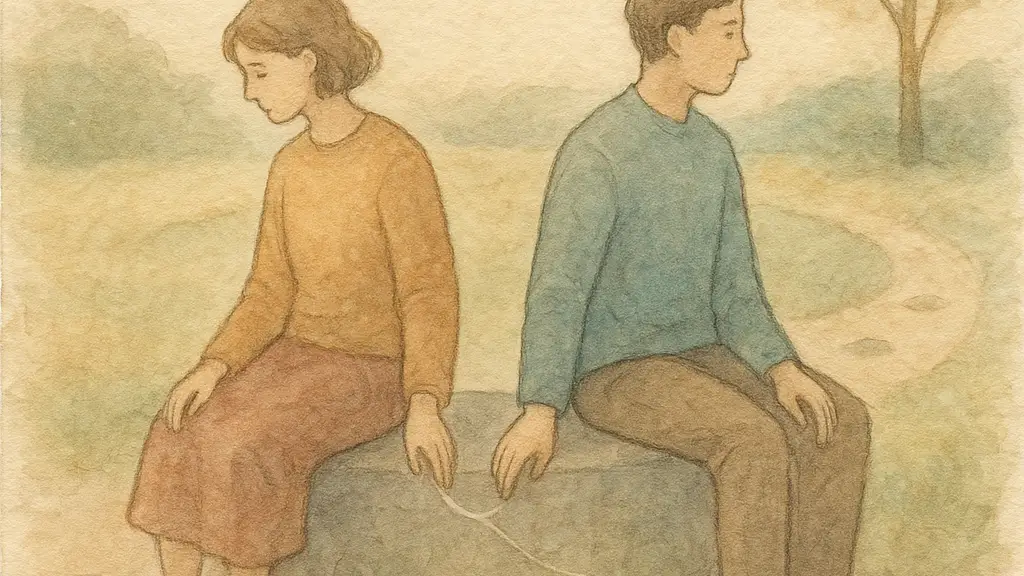
Why Closeness Can Trigger Distance Patterns
When wanting closeness meets a sudden urge to step back
You can want a hug and feel your chest close at the same time. You can long for an evening together and still hear yourself suggest doing the dishes first, then checking one more message. It is confusing because the desire is sincere. Yet the body, reading something you might not consciously notice, moves you away.
Micro-scene: You sink onto the couch and your partner reaches for your hand. Warmth rises, then tightness follows. Your jaw sets. You say, almost helpfully, I should tidy up the kitchen. You are not trying to reject them. Your system has tilted toward protection.
The body reads risk faster than thoughts form
Our nervous system scans for cues of safety or danger faster than language can keep up. A sigh, a clipped word, an expectant pause, even extra enthusiasm can feel familiar in a way that does not help. The survival brain tags it as risky based on older templates. Heart rate nudges up, breath narrows, muscles brace. Distance lowers intensity in the short term, so the body reaches for it.
This is why two truths can coexist. You want connection. Your body works to keep you intact. Withdrawal is not proof of indifference. It is an attempt to drop arousal and regain a sense of choice.
Old maps of love shape present choices
If closeness once carried a cost, the echo matters. Maybe attention was tangled with criticism: people get close to fix you. Maybe warmth swelled into engulfment: once someone turns toward you, there is no room to breathe. Or perhaps nearness was unpredictable: tenderness one moment, then a sudden storm. Today, a partner’s approach can rhyme with those older patterns, even if the person in front of you is kind and steady.
Naming this does not blame the past or doom the present. It helps you understand the reflex. Your system is not failing. It is doing a job it learned to do, sometimes too early or too strongly.
What withdrawal is trying to do for you
Stepping back works, to a point. It lowers the immediate sense of threat. It prevents saying something you will regret. It buys time. The trouble is the message it sends across the relationship. To the other person, it can look like rejection. To you, shame may creep in after the relief, because you know you care and yet you left.
When distance becomes the only lever, both people carry more weight than they need to. The good news is you do not have to choose between immersing yourself in closeness or disappearing. There is a middle move that protects safety while preserving connection.
A small, repeatable move when your system hits the brakes
Here is a micro-sequence you can practice when you feel the pull to retreat. It is designed to be short, bodily, and doable under mild stress. The aim is to keep you inside the moment without flooding either of you.
- Notice the cue. Chest tight, breath quick, shoulders up, eyes searching for the exit. Silently mark it: Threat signal is on.
- Regulate just enough. Take one longer exhale than usual. Let your eyes rest on three neutral objects in the room. Drop your shoulders one notch. Feel both feet.
- Name both truths and set a brief buffer. Say softly, to them or to yourself first: I want to be here, and my body is tight. Can we take two minutes, then sit together again?
This bridges desire and defense. It gives your system a path to settle and gives the other person a clear return point. The return point matters. Distance becomes a pause with structure instead of a disappearance.
How to share your buffer without escalating tension
The content of your words is simple. The delivery matters more. Speak slower than you think you need. Keep volume low. Avoid explaining the whole history of your reactions. You are not convincing a jury. You are letting your partner in on the plan for the next few minutes.
If you are the one hearing the buffer request, you can help. Nod. Say got it or okay. Ask if water or a brief walk to the window would help. Holding the edge together turns a potential rupture into a co-managed pause.
Practicing without pressure in ordinary moments
New patterns stabilize when you rehearse under low stakes. Pick an everyday context you both find easy. Morning coffee. A short car ride. Sitting next to each other scrolling after dinner. Agree that you will practice the sequence once this week in a tiny way, even if no threat is present.
Micro-scene: You are rinsing apples at the sink on a calm afternoon. You turn, touch your partner’s arm, and say, I am going to try our two-minute pause now, just to practice. You lean on the counter, take one longer breath, name both truths out loud on purpose, then rejoin. It takes less than three minutes. Nothing dramatic happens, which is exactly the point.
Repetition builds trust in the move. Over time, your body learns that a pause can be safe, that it leads back to closeness, and that you are not trapped by either fusion or flight. Confidence grows quietly.
Common objections your mind may raise
- It feels awkward to say this out loud. Yes. New coordination often does. Awkward is not a signal of wrongness. It is a sign you are moving differently.
- What if my partner thinks I am making excuses? Clarity reduces that risk. Including both truths and a specific return time shows care and direction.
- What if the moment is already heated? Use the same sequence, but shorten the words. Even I want this, and I am tight. Two minutes can be enough.
Perfection is not required. The practice is the progress.
Repair begins with a clear return path
Distance patterns harden when there is no declared way back. Your brief buffer creates an exit with a doorknob on the inside. It keeps you oriented to repair while your arousal comes down. It also prevents the other person from spiraling into assumptions, because they know when and how you plan to reconnect.
This is the heart of why closeness can trigger distance without meaning your love is less. Protection and longing are sharing a nervous system. A repeatable, regulated action teaches them to coordinate.
Gentle ways to get more support if you want it
If talking with a steady guide would make this easier, you can talk to E.M.O. for reflective, low-pressure support. If you prefer a quick self-assessment to notice your patterns, take the EFI. If you want personalized pacing, you can book a 1 on 1 session. Choose only what fits. The small move above already counts.
