

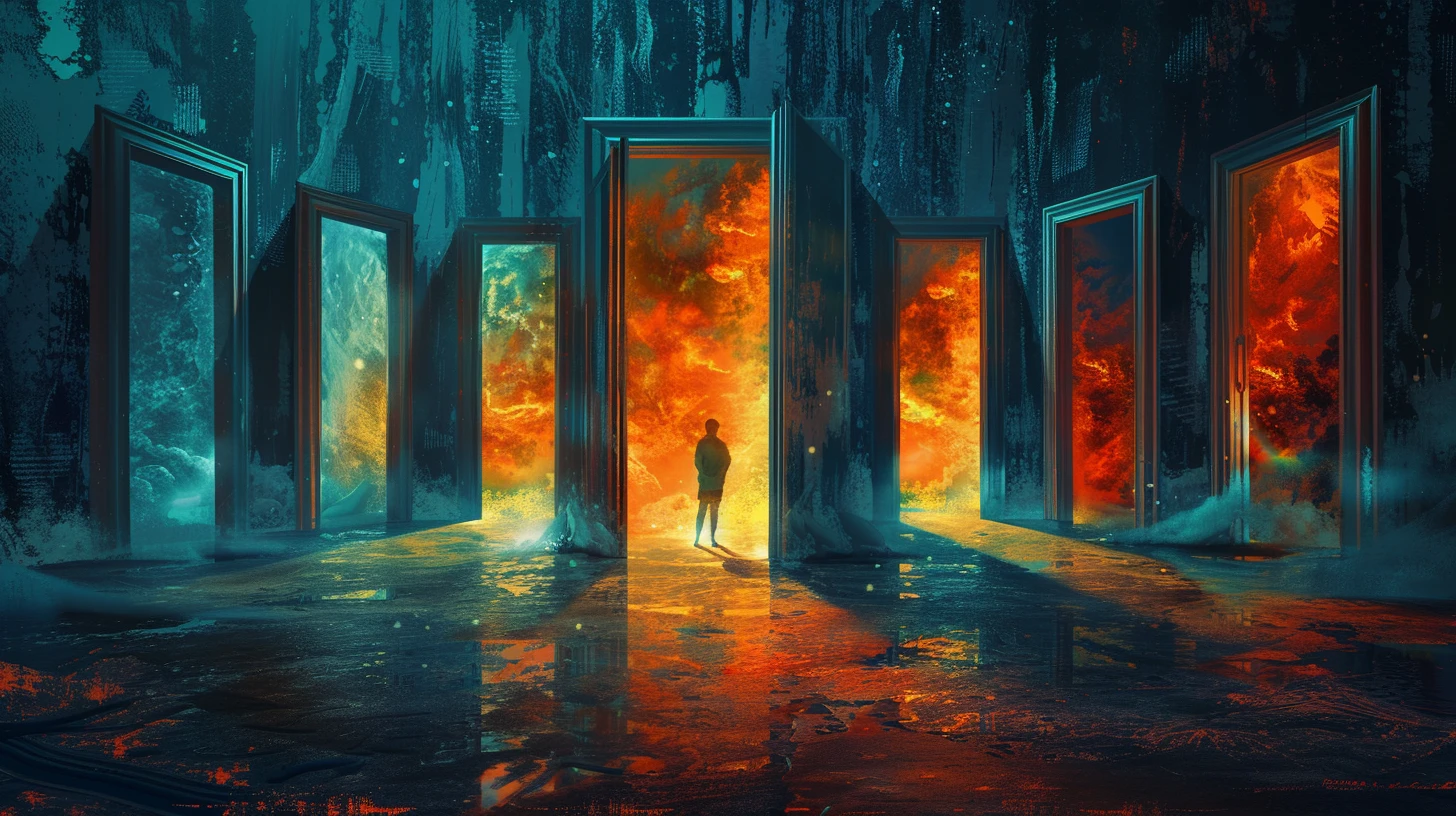
When Choosing One Path Means Losing Many
A creative person sits down to begin and does not face a lack of ideas. They face too many that are alive.
Each one could work. Each one opens a different future. And choosing one does not just move things forward. It quietly asks them to let the others go.
From the outside, this looks like hesitation. Indecision. Maybe even a lack of discipline.
From the inside, it feels very different. It feels like pressure. Like noise. Like holding five doors open at once and knowing you can only walk through one.
Before anything takes form, before a sentence is written, a sketch is drawn, a note is played, or a plan is committed, something in the body is already reacting.
The stomach tightens. The hand hovers. The eyes search for certainty that is not coming.
This is not just a thinking problem. It is a state problem. The system is trying to process too many viable futures at once, and it does not know which loss to accept.
Because every choice is a loss. Not a dramatic one, but a quiet closing. A not this, at least for now.
And the body notices that before the mind can explain it.
So it hesitates.
Not because there is no direction, but because every direction feels like it costs something real.
Then something else happens.
Even after choosing, the same pattern follows the work itself.
The opening line is rewritten before the paragraph exists. The design is adjusted before the structure is visible. The melody is refined before it is fully played. The strategy is questioned before it is tested.
From the outside, it still looks like delay.
From the inside, it feels like care.
But this is where the trap deepens.
Perfection is not just about high standards. It is often a form of protection.
As long as the work is not fully real, it can still be everything. It can still live in that untouched space where nothing has been lost and nothing has been tested.
There are two kinds of iteration.
One happens in the mind. It is elegant, controlled, and endless. The idea improves, sharpens, evolves, but never meets reality.
The other happens after something exists. Something imperfect. Something visible. Something that can actually be changed.
Only one of these moves things forward.
An idea can be improved forever without ever becoming real. That is what makes perfection so convincing. It feels like progress.
But it quietly delays the only moment that matters, when the work begins to exist.
Because until something is real, there is nothing to improve.
So the problem is not a lack of discipline. And it is not a lack of clarity.
It is the weight of choosing, and the exposure that follows.
Beginning costs something.
First, it asks you to let other possibilities go quiet. Not forever, but enough that they stop competing for attention. There is a subtle grief in that, whether you name it or not.
Second, it removes the illusion that the work can be perfected before it exists.
Once something is real, it can be seen. And once it is seen, it can be judged, changed, reworked, or even discarded.
That kind of visibility asks more of you than endless preparation ever will.
So the delay makes sense.
It protects both the possibilities you have not chosen and the work from being seen too soon.
But that protection comes at a cost.
When everything stays possible, nothing becomes usable.
At some point, the only way forward is smaller and simpler than it feels.
Let one thing exist.
Not the best version. Not the complete version. Just a version that is real enough to touch.
Because once something exists, even in a rough and unfinished way, it can finally change.
And everything else can wait in the dark a little longer, not lost, just paused.
What to do next
Start with E.M.O.
Start with a guided nervous-system support experience.
Take the EFI
Get emotional clarity and identify your current regulation pattern.
1 on 1 Session
Work directly with guided support when you want faster progress.
