

What Decides the Scale of a Reaction?
When the Trigger Looks Like the Whole Story
Some conflicts make their own case so quickly that the reaction feels built into the event. Someone says the wrong thing. A boundary is crossed. A betrayal lands. From the outside, it can seem obvious why the response became so large. The event appears to explain everything that followed.
But that is often not the full story.
Two people can meet the same kind of offense and produce very different outcomes. One answers firmly and stays close to the facts. Another spirals into certainty, retaliation, or a level of force that keeps expanding long after the original moment has passed. That difference is not always a matter of better morals or stronger character. Often, the deeper difference is the state that entered the moment before reflection had time to set the scale.
This matters because many reactions look necessary when they are actually amplified. Not invented. Not fake. Amplified. The offense is real, but the size of the answer is being set by something more than the offense itself.
A Shoreline Where Nothing Has Happened Yet
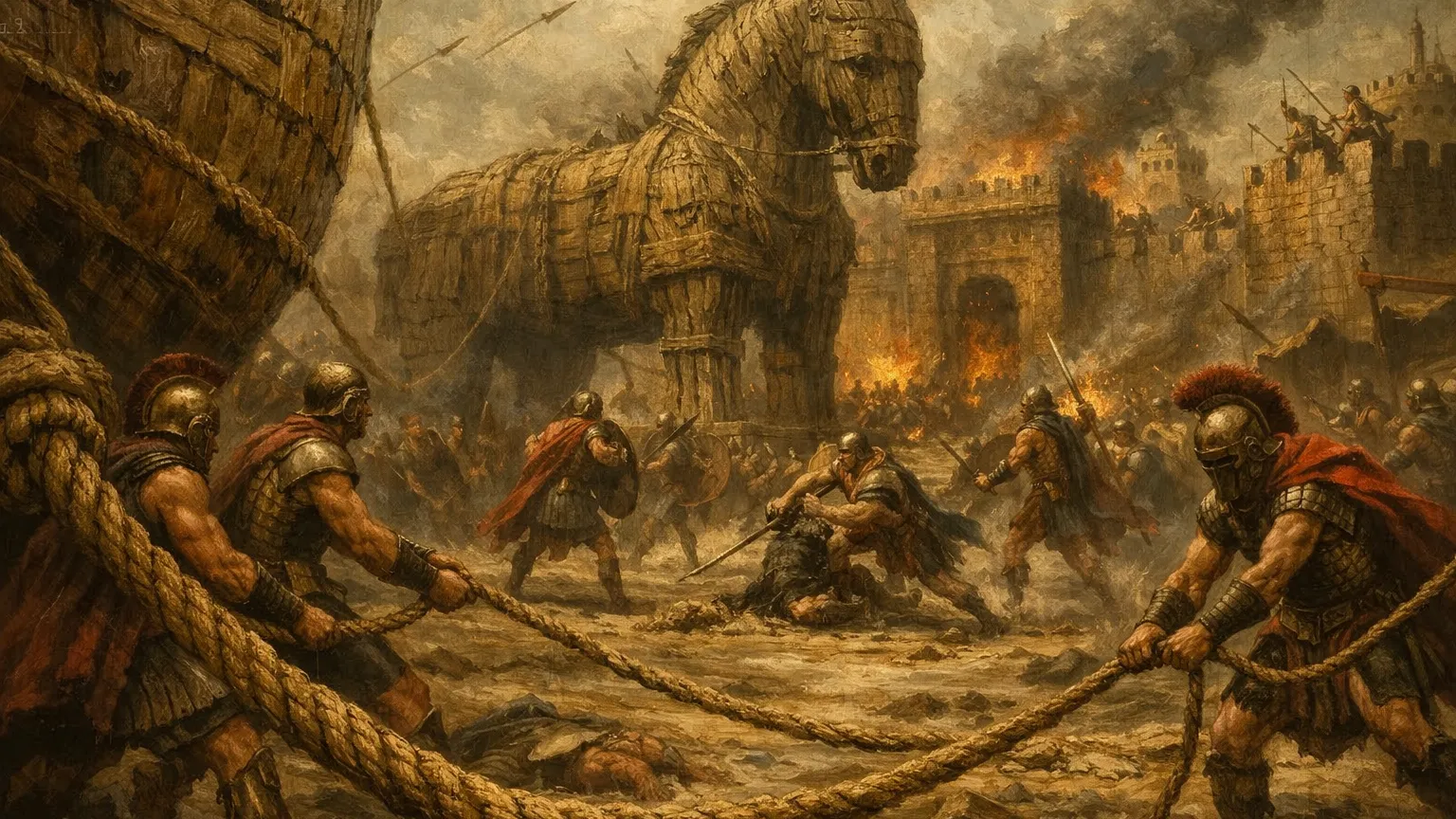
That is what makes the threshold scene around Agamemnon so useful. A brother has been wronged. War is now possible. The beach is full of materials that can become action: rope, hulls, bronze, men waiting for instructions. The visible choice looks simple. Act or do not act.
Yet the deeper fork is already present before anyone leaves the shore.
He can answer the event itself, or he can answer what the event has activated in him. Shame. Threat. Loyalty. The pressure of being watched. The fear that restraint will be read as weakness. All of that can enter the moment and begin setting the size of the response before the response is even visible.
That is why the scene matters. The ships can still be at rest, and scale is already being decided. Orders have not fully gone out. Men have not fully moved. But the reaction is beginning to organize around an internal state, not just an external fact.
The Choice Underneath Act or Do Not Act
Most people are taught to think of conflict in simple binaries. Say something or let it go. Escalate or deescalate. Defend yourself or stay quiet. Those are real choices, but they are not the first ones. The first choice is often less visible.
Am I answering what happened?
Or am I answering what happened inside me when it happened?
That hidden distinction changes everything. A response shaped by the event asks what actually occurred, what boundary was crossed, and what consequence fits. A response shaped by activation answers the surge. It answers the heat in the chest, the tightening in the jaw, the sudden need to restore status, the almost physical demand to match intensity with intensity.
From the outside, those two responses may begin the same way. A call is made. A meeting is scheduled. A hard sentence is spoken. Ships gather, orders go out, men move. The difference is still invisible at first. It lives in what is driving the scale.
Why Heat Often Borrows the Language of Necessity
One reason this is hard to see is that activation rarely introduces itself as activation. It tends to arrive wearing more convincing clothes. It feels like principle. It feels like clarity. It feels like urgency. It feels like, "Someone has to do something."
And sometimes someone does have to do something. The problem is not action. The problem is when an activated state makes a larger answer feel self-evidently correct before judgment has caught up.
Shame does this. Threat does this. Public exposure does this especially well. If an offense lands in a part of the self that already feels raw, the body can start enlarging the stakes on its own. What might have remained a bounded injury begins to feel like a referendum on identity, loyalty, competence, or power. Once that happens, force starts recruiting support. The mind tells a story that fits the state. The body reads speed as wisdom. Escalation starts to feel like proportion.
This is why some reactions become much bigger than the trigger without anyone consciously deciding to make them bigger. The system is already mobilized, and then it goes looking for a reason that sounds clean enough to defend.
The Same Pattern in Ordinary Rooms
You can see the same structure far away from myth.
A person walks into a meeting after a week of quiet tension with a colleague. One dismissive comment lands, and suddenly the whole exchange feels loaded with history, disrespect, and the need to set the record straight. The reply comes out sharper than intended. By afternoon, more people are involved, old emails are being reread, and the issue now seems much larger than the sentence that started it.
The moment did matter. But the moment did not arrive in empty space.
This is why families can turn one late text into an argument about loyalty. It is why teams can turn one vague criticism into a power struggle. It is why institutions can turn one offense into a campaign. The visible trigger is only part of the story. The entering state matters just as much, sometimes more, because it determines how much meaning, danger, and force will be attached to the event before anyone pauses long enough to measure.
Seeing Activation Without Letting Yourself Off the Hook
None of this removes responsibility. In fact, it sharpens it.
If you believe the event alone dictated the outcome, then your range of accountability stays narrow. You can point to the trigger and treat the rest as inevitable. But if state helped set the scale, then responsibility includes more than whether the offense was real. It includes whether your shame, fear, or retaliatory momentum quietly took over the sizing of the answer.
That is not a moral condemnation. It is a more precise description of how people work.
A regulated response is not a soft response. It may still involve a refusal, a consequence, a departure, a public correction. The difference is that it stays tied to the original wrong instead of becoming a vehicle for the whole activated state. Naming activation does not excuse behavior. It prevents activation from disguising itself as truth.
What a Measured Answer Has to Protect
A more proportionate answer usually begins earlier than people think. Not after the speech. Not after the email. Not after the room has already polarized. It begins at the point where the body starts arguing for scale.
That earlier moment is often quiet. It sounds like a few simple questions. What actually happened? What is being activated in me right now? What answer fits the event, not just the surge? What story is arriving too quickly to be trusted yet?
Those questions do not make a person passive. They make room for sizing. And sizing is one of the most human parts of judgment. Without it, every wound risks becoming total. Every threat starts feeling absolute. Every response begins to borrow magnitude from the state instead of clarity from the facts.
A measured answer protects two things at once: the reality of the offense and the possibility that you do not have to hand your whole nervous system the right to decide its scale.
The Next Question That Changes Everything
Once you can see this pattern, many conflicts start to look different. Not smaller, necessarily. Just more legible. You begin to notice that scale is often set before the visible action, while the ships are still at rest, while the meeting has not fully turned, while the first hard sentence is still forming.
That recognition can be sobering. It can also be relieving. Some reactions are not proof that the situation was enormous from the start. They are proof that the entering state was already shaping what the situation became.
And if that is true, then one of the most useful questions is not only why a bad decision happened. It is what was already happening before the bad decision had the chance to look necessary.
What to do next
Start with E.M.O.
Start with a guided nervous-system support experience.
Take the EFI
Get emotional clarity and identify your current regulation pattern.
1 on 1 Session
Work directly with guided support when you want faster progress.
