

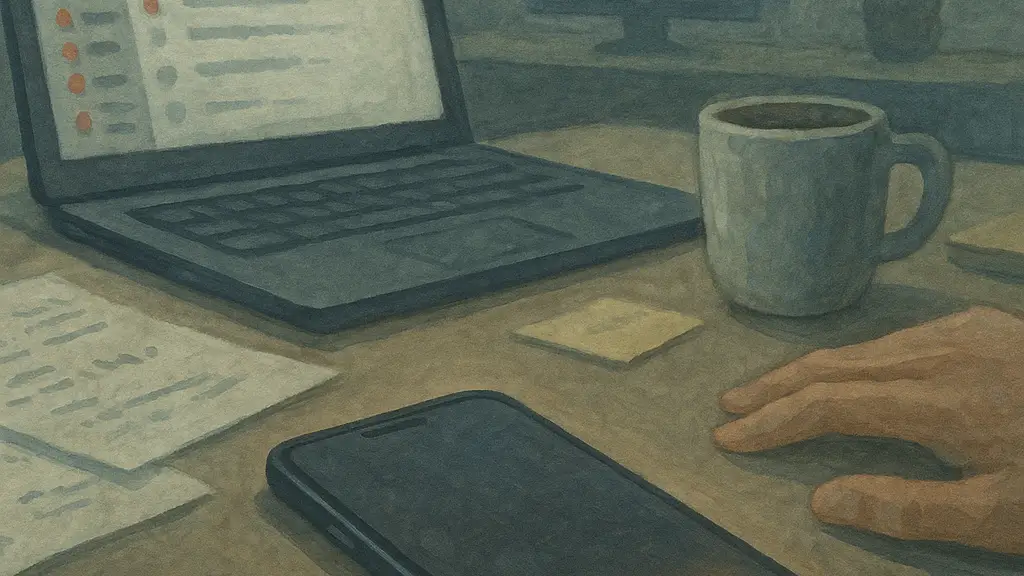
When Your Body Decides the Day Is an Emergency
At 2:17 p.m., the meeting is still running, your lunch is still closed, Slack keeps flickering at the side of the screen, and your phone lights up with the next reminder. Nothing dramatic has happened. But your shoulders are high, your jaw is tight, and your attention has narrowed into that familiar feeling that everything needs you at once.
This is one of the harder parts of a busy day to explain, especially if you are already fairly self-aware. You may know what stress feels like. You may know what usually helps. And still, in the middle of ordinary work, your body can begin reading every new input as urgent before your mind has fully caught up.
That matters because once urgency takes over, people often stop expecting support to be possible in the moment. They postpone it. Later, when there is more time. Later, when there is privacy. Later, when the meeting ends, the inbox settles, the house gets quiet, or the day stops asking anything new.
Later can be useful. But it is not the only opening.
Why Calm Starts to Feel Like Something You Have to Earn
Many people assume regulation has to be a full event. It has to look like a walk, a meditation, a journal page, a closed door, ten uninterrupted minutes, or a structured process that you can actually do properly. If those things help you, that is fine. The problem is not that they are wrong. The problem is that a busy day rarely offers them at the exact moment your system starts to tip.
So the mind makes a quiet bargain: if I cannot do this well, I will not do it yet.
That bargain sounds reasonable, but it often leaves you stranded in the most activated part of the day. You do not need a grand interruption. You need a believable one.
A small moment of calm is not about creating a completely different emotional state on command. It is about giving the body one clear signal that not everything happening around you is an immediate threat. That distinction matters. If you try to force yourself into peace, you may feel more split inside. If you offer your system one steadier cue, you make less trouble for yourself.
This is why small, body-based moments tend to work better in real life than ideals do. They ask for less. They also respect the truth of the moment. You do not have to pretend the day is fine. You do not have to become serene. You only have to interrupt the stress pattern enough for the next minute to become more workable.
What a Small Calm Moment Is Actually Meant to Do
The purpose of a small calming pause is not to solve the whole day. It is not a productivity trick disguised as self-care. It is not proof that you should be able to handle endless pressure with better technique. And it is not a promise that sixty seconds will undo what your body has been carrying for weeks or months.
Its job is much narrower, and because it is narrower, it is often more realistic.
A small pause lowers the charge just enough for choice to come back online.
That might not sound dramatic, but in practice it changes a lot. When stress is peaking, your choices tend to collapse into speed, avoidance, or overcontrol. You answer the loudest message, skim five things at once, push through hunger, tense harder, or make decisions from the feeling that you are already behind. A brief regulating moment does not erase the load, but it can soften the urgency enough for one better next move to appear.
Sometimes that next move is as simple as finishing the sentence you were writing instead of abandoning it for three incoming pings. Sometimes it is asking for five minutes before responding. Sometimes it is taking one sip of water and noticing that your feet are still on the floor. Sometimes it is seeing that one task can wait.
This is a modest form of care, but modest is not the same as insignificant. Small regulation moments are often what make steadier choices possible inside ordinary life.
The Small Shift Most People Discount
One reason people skip these moments is that the shift sounds too small to matter. A hand at the collarbone. One fuller exhale. A sentence that tells the truth without escalating it. Compared with the size of the day, it can seem almost laughably small.
But small is not the same as trivial.
The difference between reacting from urgency and responding with one inch of choice is often narrow. It may not look impressive from the outside. No one else may notice that your shoulders dropped slightly, or that you answered the next message from a steadier place, or that you finished one thought before letting five new inputs pull you apart. But inside the day, that margin can change what happens next.
Athletes understand this kind of margin. A tenth of a second can change an outcome. In daily life, the margin is quieter: one slower breath, one physical point of contact, one honest sentence, one moment where the body gets a different signal before the next decision is made.
This is the real threshold. Not forcing yourself to be calm. Not pretending stress is your fault. Simply noticing that "fine" and "slightly steadier" are not the same state, and that the smaller state change is often available before a larger reset is possible.
Once you feel that difference a few times, the old assumption that it would not matter starts to weaken. You begin looking for the small opening earlier, not because every moment has to be optimized, but because your next choice deserves better conditions than pure urgency.
A Tiny Practice You Can Use Without Leaving the Room
A body-based, somatic-informed pause can be simple enough to use while your day is still happening.
Start by noticing the honest state of things. Not the polished version. Not the version that says you are fine because you should be fine. Just the simple truth: this is a lot. My system is activated. The day is getting loud inside me.
Then add one physical point of contact. You might rest your fingers on the side of the other hand. You might place a hand lightly at the collarbone. You might simply press both feet into the floor and feel the chair holding your weight. If you want a more specifically EFT-based option, you might stimulate the 9 gamut point while taking slower, deeper breaths. The specific gesture matters less than the quality of contact. You are giving the body something clear and present to register.
From there, let your breath settle a little if it wants to. No need to optimize it. One fuller exhale is enough.
Then give yourself a sentence that does not argue with reality. Something like, "This is a lot, and this minute is survivable."
That phrasing helps because it does not demand instant peace. It does not shame you for feeling overloaded. It does not skip past the pressure. It names the pressure and places it in a frame your body can sometimes hear more easily. This minute is survivable. Not the whole quarter. Not the whole project. Not the whole relationship or future. This minute.
If that sentence does not fit your voice, use one that keeps the same spirit. The key is honesty without escalation. You are looking for a statement that steadies, not one that performs strength.
You may notice very little at first. That is normal. The win is not a dramatic wave of relief. The win is a slight drop in intensity, a touch more space in the chest, a little less compulsion, or a small return of perspective. Sometimes the shift is so subtle that you only see it in the next decision you make.
What Changes After the Pause
The meeting may still be going. The inbox may still be full. The child may still be crying in the next room. The deadline may still exist. A useful pause does not require the world to cooperate.
What it can change is your relationship to the next sixty seconds.
Instead of acting from pure alarm, you may be able to choose one thing. Finish the note. Close one tab. Stand up before answering. Ask a clearer question. Admit that you need a transition before the next task. These are not glamorous moves, but they are often the ones that prevent the day from hardening into a long chain of reactivity.
It is also worth normalizing something here: needing small regulation moments in the middle of a workday is not a sign that you are failing at adulthood. It is a sign that you have a body, a workload, and a nervous system that responds to accumulation. Many thoughtful, competent people wait too long to intervene because they assume only larger forms of care count. In practice, small honest interventions are often what keep the rest of the day from getting more expensive.
Over time, this kind of pause can also teach you something important. Support does not always have to happen outside your life in order to be real. Sometimes it happens in the middle of the spreadsheet, in the parked car before walking inside, or while water is running for tea. Not as a grand ritual. Just as a quiet refusal to let urgency make every decision for you.
When a Small Opening Is Enough for Now
There are days when you will need more than this. A fuller reset. A longer conversation. Rest that cannot be compressed into a minute. That does not make the smaller pause pointless. It makes it proportional.
A small moment of calm is often the first opening, not the finish line. It is the point where your body stops spiraling just enough for choice to return. And once choice returns, the next form of support becomes easier to recognize.
If this brief practice helps even a little, that is worth respecting. It means your system may not need perfection before it can respond. It may only need one clear, grounded interruption inside the day you are already living.
Over time, that changes what you expect from a moment. You are not controlling every condition around you. You are not turning stress into a personal failure. You are teaching your body that support can enter before the day stops, and that the state you bring to the next minute is not always as fixed as urgency makes it seem.
From there, a slightly longer [five minute nervous system reset](a-5-minute-nervous-system-reset-step-by-step) can make more sense, not as a replacement for this moment, but as the next layer of support when you have a little more room.
What to do next
Start with E.M.O.
Start with a guided nervous-system support experience.
Take the EFI
Get emotional clarity and identify your current regulation pattern.
1 on 1 Session
Work directly with guided support when you want faster progress.
