

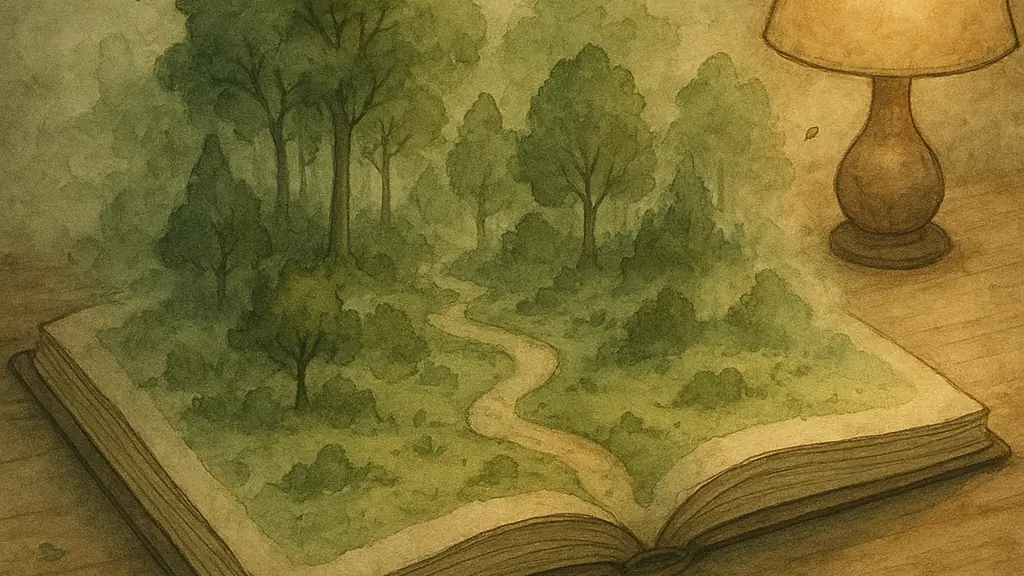
The Enchanted Forest Did Not Disappear
There is a quiet grief that comes with growing up that many people never name as grief.
It is not the obvious kind of loss. Nobody died. Nothing dramatic happened. Your life might even be working.
And still something went missing.
It is the moment play gets traded for proof. It is the moment joy gets postponed in the name of being “enough.”
Most people call this responsibility. They call it discipline. They call it adulthood.
But the body often experiences it as a subtle closing.
Because play is not extra. Play is a safety signal. It is one of the ways the nervous system communicates, “The environment can hold spontaneity.” When play disappears, it can mean the system no longer trusts safety without performance.
When Life Becomes an Audition
I was struck by a reflection from Gabor Mate. He once said that if he could live his life over, he would not do it the same way. Not because he failed, but because he worked so hard to justify his existence that he missed what mattered most.
The play. The summers. The unstructured time with the people he loved.
That line points to a pattern many of us carry without realizing it:
- I must earn my place.
- I must justify taking up space.
- I must prove I am worth being here.
Those are not adult insights. They are early rules.
When those rules are running, life becomes an audition. Even a “good” life can feel like a performance you cannot pause. Play starts to feel irresponsible. Joy starts to feel like something you must deserve. Rest starts to feel like theft.
Why Winnie-the-Pooh Makes Grown Adults Cry
Mate talked about the ending of Winnie-the-Pooh, where Christopher Robin has to leave to go to school, and the story promises that no matter what happens, the little boy and his bear will always be playing together in the enchanted forest.
If that line brings tears, it is usually not sentimentality. It is recognition.
It is the recognition of a part of you that remembers a different way of being alive. A way that did not require proof. A way that assumed belonging.
The enchanted forest is not literally childhood. It is a nervous system state: safe enough to be unproductive, silly, slow, and present. It is the inner place where time is not a threat.
The Enchanted Forest Gets Covered Over
Most people do not wake up and decide to sacrifice joy. It happens quietly.
You start postponing. You start narrowing. You start treating your own aliveness like a reward you might receive later.
And later becomes a moving target.
Underneath is usually some version of a learned belief:
- If I relax, something bad will happen.
- If I play, I will fall behind.
- If I enjoy myself, I am being irresponsible.
- If I stop producing, I will lose love, respect, or safety.
Those beliefs did not come from nowhere. They are learned. Sometimes they were taught directly. Often they were modeled. Sometimes they were built as survival strategies in environments where play was not safe.
Returning Is Not Indulgence
This is why reconnecting with play is not indulgent. It is essential.
The adult nervous system still needs proof of safety. Joy is one of the proofs.
Returning is not forcing yourself to be playful. Returning is reopening the door with something small enough that your system can say yes.
A walk without a purpose. Music without a productivity goal. Ten minutes of doing something “pointless” and staying with the discomfort that says you have to justify it.
That discomfort is not a problem to fix. It is information. It is the old rule trying to keep you safe: “Do not feel good unless you can defend it.”
The Small Experiment That Rewrites the Rule
If you want the enchanted forest to feel real again, think in experiments, not declarations.
Not, “I am going to become playful.”
But, “I am going to prove to my nervous system that joy does not collapse my life.”
That proof is built gently. One small yes at a time. One moment where you let yourself enjoy something without earning it first.
The Part That Learned the Rule
If you have a strong reaction to “pointless” joy, it usually means a part of you is still guarding the system.
That part is not your enemy. It is not a flaw. It learned a rule in a context where the rule made sense.
Maybe play invited criticism. Maybe joy made someone else angry. Maybe relaxation was punished. Maybe you became the “good kid” because the alternative was chaos.
When a nervous system learns that safety is conditional, it adapts.
It narrows. It performs. It postpones.
And then, years later, you end up with the adult version of the same contract: I will let myself feel good after I prove I am allowed to.
Naming that contract matters because it stops the self-blame loop. The problem is not that you are broken. The problem is that a protective strategy became a permanent lifestyle.
A More Honest Question
If you want to find the enchanted forest again, the question is not, “How do I force myself to play?”
The better question is: what does my system think will happen if I stop justifying?
When you ask it that way, the work becomes precise.
You can listen for the prediction:
- “If I relax, I will fall behind.”
- “If I enjoy myself, I will lose respect.”
- “If I stop producing, I will lose love.”
- “If I let my guard down, something bad will happen.”
Then you choose one small experiment that challenges the prediction without overwhelming the system.
Not hours. Minutes. Not a new identity. A small act of permission.
The goal is not to become carefree. The goal is to teach the nervous system one new fact: joy can exist without collapse.
What Inner Peace Actually Looks Like Here
Inner peace, in this frame, is not constant calm. It is the ability to return.
Return to your body. Return to your aliveness. Return to the part of you that knows play is not irresponsible.
That return often starts with something almost embarrassingly small:
- sit in the sun for five minutes
- watch something that makes you laugh and do not justify it
- move your body in a way that is not exercise
- call a friend and do not turn it into a task
If a guilty voice shows up, do not argue with it. Notice it.
That voice is the old contract.
And every time you choose a small yes anyway, you are rewriting it.
We do not stop playing because we grow up. We stop playing because we forget that we are allowed to.
Tags: #InnerPeace #NervousSystem #Play #Joy #EmoAlchemy
Category: Inner Peace (EmoAlchemy Gateway)