

Regulating in Culture
7 min read
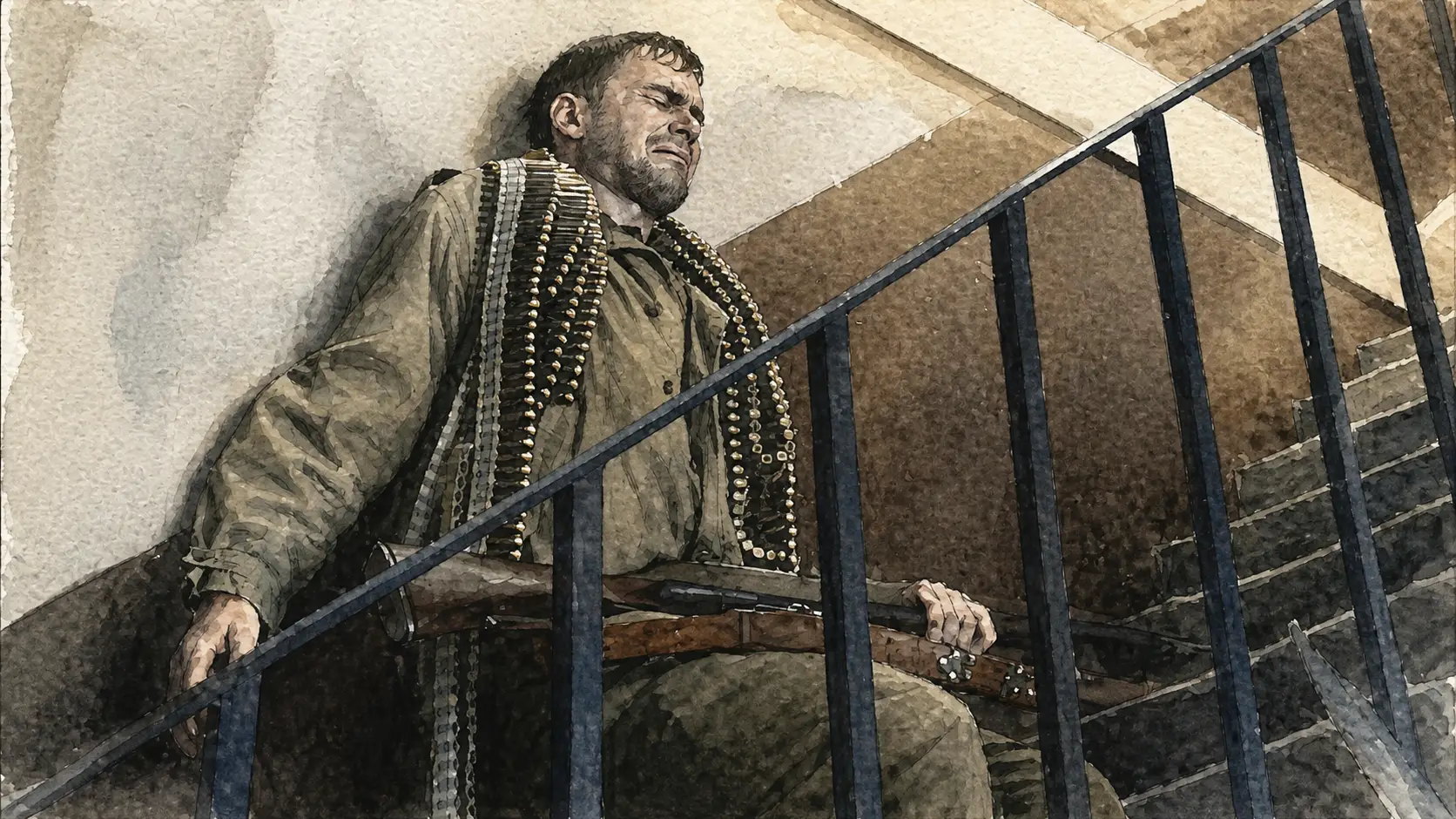
In one scene from Saving Private Ryan, a man reaches a stairwell with his hand near the rail while something urgent unfolds just beyond him, and he stops. The distance between seeing what matters and doing something about it is suddenly very small. From the outside, that closeness creates a hard, almost automatic judgment. He should move. He should help. He should become equal to the moment.
When the body does not meet the moment
What makes the scene painful is not that the demand is unclear. It is that clarity of demand does not guarantee clarity of action. Threat, speed, responsibility, and helplessness can arrive faster than a body can turn alarm into movement. A person can know what matters and still lose access to a next step. When that happens, freeze gets read as character. But it can also be information: overwhelm has outrun available choice.
Freeze hides in respectable places
Most people will never know a stairwell like that. They will know the quieter versions.
An email sits open on the screen. You have read it three times. The reply is not mysterious, and the stakes are not life or death, but your chest tightens anyway. You get up to refill your water, check something small, tell yourself you will answer in ten minutes, and an hour passes with the message still waiting.
Not every delay, silence, or failure to act is freeze. Avoidance, disagreement, lack of preparation, competing priorities, and deliberate delay can all be part of the picture. The point is not to give every pause the same name. It is to notice the particular experience of understanding what matters while being unable to access a next move.
Many capable adults know that experience. They manage work, keep appointments, take care of people, and carry a normal-looking life. Then one conversation, one request, one decision, or one visible move hits a pressure point, and the system goes blank. Words disappear in an argument. A form stays unfinished. A simple answer feels physically unavailable. The problem is not always lack of insight. Sometimes the insight is intact and access to action is what drops out.
Shame is a second threat
This is where shame usually enters with great confidence. It explains the freeze as weakness, immaturity, avoidance, or some private flaw that has finally been exposed. Because shame speaks in decisive language, it can feel like realism. It sounds like accountability. It sounds adult.
But shame often does something less useful. It adds a second layer of threat to a system that is already under strain. The body is already braced, narrowed, and trying to manage competing demands. Then the mind adds a verdict: now you have also failed the test of who you are supposed to be. That extra accusation rarely opens choice. More often it hardens the shutdown.
The original pressure is real. Then the shame about the pressure becomes its own event. Now there are two things to manage: the moment, and the meaning being made of the moment.
Responsibility and compassion can share the same frame
Reading freeze as overload is not the same as excusing harm. Some delays matter. Some silences land badly. Some moments do call for repair, apology, training, different support, or clearer boundaries. Responsibility remains.
The important distinction is where you start. If you begin with condemnation, you make the person into the whole explanation. If you begin with overload, you can ask better questions. What actually happened here? What was too much, too fast, or too charged? What support was missing? What would make a wiser response more available next time? What needs to be repaired now?
Repair does not have to wait for a perfect explanation. An unanswered email might begin with something simple: “I saw this and got overwhelmed. I’m sorry for the delay. I can give you a fuller answer by Thursday.” The particulars will vary, but the principle is useful. A person can acknowledge an impact and make a workable commitment before every feeling is resolved.
That frame is not softer in the shallow sense. It is more exact. It refuses the false simplicity of saying either, “Nothing was wrong,” or, “This proves everything about you.” It leaves room for consequence without making shame the primary tool.
The first task is to restore a little choice
Many people imagine the fork as cowardice versus courage. That is often too late in the sequence. A more useful first fork is overload versus enough regulation to recover a little choice.
That difference changes what you ask of the moment. Instead of demanding a complete performance of strength, look for one reachable condition that would make movement possible. It may be feeling both feet on the floor. It may be one full exhale instead of three shallow ones. It may be asking for the question in writing. It may be saying, “I need a minute to answer that well.” It may be breaking the task down until the body can meet the first piece instead of carrying the weight of the whole outcome at once.
These are small moves. That is the point. They are not meant to prove bravery. They are meant to recover access. Sometimes the next right action does not arrive because a person has found the perfect insight. It arrives because the body is no longer being asked to leap an impossible distance in one motion.
Some situations ask for more than a calming trick
There is a limit to what should be expected from a single technique. Not every freeze can be solved by noticing the floor or lengthening an exhale. Some situations require safety, distance, training, collective support, or time. Some require another person taking over part of the load. Some require the kind of preparation that cannot be improvised in the moment.
This matters because people often turn a useful regulation idea into another instrument of self-attack. They think, “If I had done the breathing, I would have handled it better,” and now the tool itself becomes part of the shame story. That misses the point. Regulation is not a guarantee of heroism on demand. It is a way of making a little more room between alarm and action when that room is actually available.
Sometimes the most regulated move is not immediate performance. It is recognizing that the conditions for good action are not present yet, and refusing to pretend otherwise.
What maturity can sound like under pressure
Maturity in these moments is often less dramatic than people expect. It does not always sound like a powerful speech or a decisive pivot. Sometimes it sounds like, “I am losing words and I do not want to answer too fast.” Sometimes it sounds like, “I can do the first part, not the whole thing.” Sometimes it sounds like, “I need help with this one.”
Adult steadiness is not the absence of overload. It is the growing ability to notice overload without immediately turning it into a moral verdict, to separate consequence from identity, and to get honest about what would restore access rather than doubling down on force.
That is less dramatic than the usual stories about courage, but often more useful.
One more available second
The hoped-for turn is smaller than redemption. A person does not become fearless. The stairwell does not become easy. The body does not promise perfect action next time. What can change is simpler and more believable.
You notice that the next step has disappeared. You resist making shame the interpreter of that disappearance. You look for one condition that gives choice a little more room. From there, action may become available. If it does not, support may be the truer next move.
For many people, that is the first meaningful shift: not a new identity or a dramatic breakthrough, just one more available second. One second in which language returns, a hand moves, a message gets answered, or a clear pause replaces a panicked one.
And if you want to stay with the question a little longer, the next place to look is what happens before a bad decision, when pressure starts narrowing access well before the visible mistake appears.
What to do next
Start with E.M.O.
Start with a guided nervous-system support experience.
Take the EFI
Get emotional clarity and identify your current regulation pattern.
1 on 1 Session
Work directly with guided support when you want faster progress.
