

What If
10 min read
There are moments in family life when fast compliance can feel like the only proof that anything is working. The shoes still are not on. Someone is crying over the wrong cup. The clock is louder than usual. The adult in the room can feel the body begin to harden around the task ahead.
When Quick Obedience Looks Like Success
In those moments, control often looks efficient. A sharper tone changes the air. A threat gets movement. The room reorganizes itself around the adult's activation, and for a minute that can feel like relief.
It makes sense that this happens. Parenting asks a nervous system to do too much, too often, with too little recovery. Many adults are not reaching for control because they are cruel or careless. Often control is the shape stress takes when there is no margin left. The surge and the action can arrive so close together that the adult only recognizes the pattern afterward.
Still, there is a quiet question underneath the visible outcome. If a child complies because they can feel the adult's charge rising, what are they actually learning? Are they learning how to work with frustration, disappointment, and limits inside their own body? Or are they learning that safety depends on tracking someone else's intensity?
That is a different measure of success. It is slower. It asks for more honesty. It also changes what authority might mean.
The Body Cost Adults Already Know
Many caretakers already understand this in a private way, even if they do not have language for it. They know the feeling after the moment has passed. The child did what they were told, but the adult is left with a buzzing chest, a tight jaw, or a low ache of regret that lingers into the next task.
That after-feeling matters.
It tells the truth about how much force was required to produce the result. It also hints that the moment was not just about behavior management. It was about two nervous systems in contact, one with more power than the other.
This does not mean every strong tone is damaging or every imperfect moment needs to be examined under a moral microscope. Adults are human. Family life is messy. Limits are real. Consequences are real. Children do not become secure because adults never strain.
What matters is the pattern being modeled. If the dominant lesson is that power arrives as pressure, then children may become highly skilled at reading pressure. They may learn to comply, avoid, brace, appease, or push back. But that is not the same as learning regulation.
What Parenting Culture Would Measure Differently
What if parenting culture stopped treating immediate obedience as the clearest evidence that adult authority was working?
What if the first measure was not only how quickly a child complied, but what kind of nervous-system learning the moment created?
A family, school, or community built around that question would still care about limits. It would still care about safety, schedules, responsibility, and follow-through. But it would measure success differently. Not only: did the child stop? Also: did the adult stay connected enough that the limit remained clean? Did the child learn what comes next without having to monitor threat? Was repair available when the adult overreached?
In a control-first model, the visible metric is compliance. Did the child stop arguing? Did they move faster? Did the room get quiet?
Those metrics are not meaningless. Sometimes a child needs to stop. Sometimes movement matters. Sometimes quiet is necessary.
But they are incomplete.
A regulation-modeling culture would ask additional questions. How much fear did the adult need to use to get the result? Did the child understand the limit, or only the threat level? Did the adult have enough support to stay steady? Was the rule predictable enough that the child did not have to guess what mood the adult was in? After rupture, was there a path back into connection?
That would change the whole frame. Parenting would no longer be judged only by whether the child obeyed in the moment. It would also be judged by what the child learned about authority, pressure, repair, and self-control over time.
Structure Without Threat
This does not erase the need for leadership. It sharpens it.
Adults still lead. They still interrupt harmful behavior. They still make decisions children cannot make for themselves. They still protect schedules, bodies, and structures that keep family life functioning. The shift is not toward permissiveness. The shift is toward making adult regulation part of the authority itself instead of treating it like an optional extra.
That changes the atmosphere of a limit. A boundary no longer has to arrive wrapped in overwhelm. A consequence no longer has to borrow power from threat. A correction can remain clear without making fear do the work.
This is where the idea has to stay honest. Many parents do not have a spacious pause available. Chronic stress, sleep deprivation, financial pressure, unsupported labor, and old nervous-system patterns can make the surge and the action arrive almost together.
In that state, control is not always a philosophy. Sometimes it is stress moving faster than reflection.
A regulation-modeling culture would not respond by telling individual parents to be calmer. It would ask why so many parents are being asked to model regulation without enough recovery, support, predictability, or shared structure to make that possible.
For some children, the most regulating thing is not extra warmth in the moment. It is predictability. A clear limit, repeated consistently, can feel safer than a warm adult who keeps changing the rules while trying to stay gentle. Regulation modeling does not mean replacing structure with emotional nuance. It means keeping the structure clean enough that the child does not have to track adult threat in order to understand what comes next.
The Ordinary Scene Where The System Shows Up
A child is on the floor by the front door refusing to put on shoes. The bag is packed. The keys are already in hand. The adult is late, and the body knows it before the mind can form a sentence. Heat rises, thoughts narrow, and the temptation is immediate: make this stop.
That moment looks private, but it is not only private. It carries the whole system around the adult. The sleep they did not get. The support they do not have. The schedule with no margin. The inherited scripts about obedience. The public suspicion that a parent has failed if a child is loud, slow, angry, or hard to move.
In one version of the moment, the adult's activation becomes the main event. The child moves, eventually, but mostly because the room has become too charged not to. In another version, the limit is still firm: we are leaving, the shoes are going on, I am helping this happen. The difference is not softness. The difference is that the adult notices the surge instead of handing it the microphone.
That is a small distinction from the outside. Inside a child's body, it may be a very large one.
The child is still meeting frustration. They are still learning that life contains limits they did not choose. But they are also learning something about what steadiness looks like under pressure. They see that authority can stay connected while staying firm. They see that a person's feelings do not have to disappear in order for structure to hold.
That is the horizon shift. The question is not only whether one parent can pause in one hallway. The question is what parenting culture would have to value, fund, teach, and normalize if regulation modeling were treated as a serious developmental aim rather than a private act of heroic self-control.
Why Control Can Feel So Convincing
Control often wins the argument because it produces visible results. The room gets quieter. The movement happens. The adult gets a short drop in internal pressure. That sequence is powerful reinforcement.
Regulation modeling is harder to trust because its effects are less dramatic in the moment. It may not look efficient at first. It does not always create instant calm. It can feel almost invisible while it is working.
But invisible is not the same as ineffective.
A child who experiences clear limits from an adult who can notice, recover, and repair is learning several things at once. They are learning that distress can exist without taking over the whole room. They are learning that a relationship can survive tension. They are learning that authority does not have to disappear when emotion appears.
This is part of why the work often feels slower but more durable. It is not only shaping behavior. It is shaping what the child expects human connection to feel like when pressure enters.
Repair Is Part of Leadership, Not Evidence of Failure
No adult does this cleanly all the time. Most people carry stress, unfinished history, fatigue, and too many demands into the room with their children. Sometimes the sharp edge comes out first. Sometimes the limit is true, but the delivery leaves a bruise.
Repair matters here, not because adults must become endlessly self-disclosing, but because repair teaches its own form of stability.
When an adult returns after overreach and says, in effect, the limit was real and my delivery went too far, the child receives a rare kind of clarity. Authority is not collapsing. Accountability is not disappearing. The relationship is being restored without pretending nothing happened.
That kind of repair does not weaken structure. It matures it.
It also relieves children of a burden they were never meant to carry, which is the burden of making sense of adult dysregulation on their own. Instead of quietly concluding, "Big feelings mean disconnection," they begin to see another possibility. Big feelings can be named. Missteps can be owned. Contact can be rebuilt.
What the Preferred Future Might Actually Feel Like
If parenting started with regulation modeling instead of control, the change might not look dramatic from across the room. It might look ordinary. A parent pauses for one breath before speaking. A teacher lowers volume instead of raising it. A caretaker keeps the consequence intact but does not add extra force to make the point land.
The preferred future is not a fantasy home where children are easy and adults are endlessly composed. It is more grounded than that.
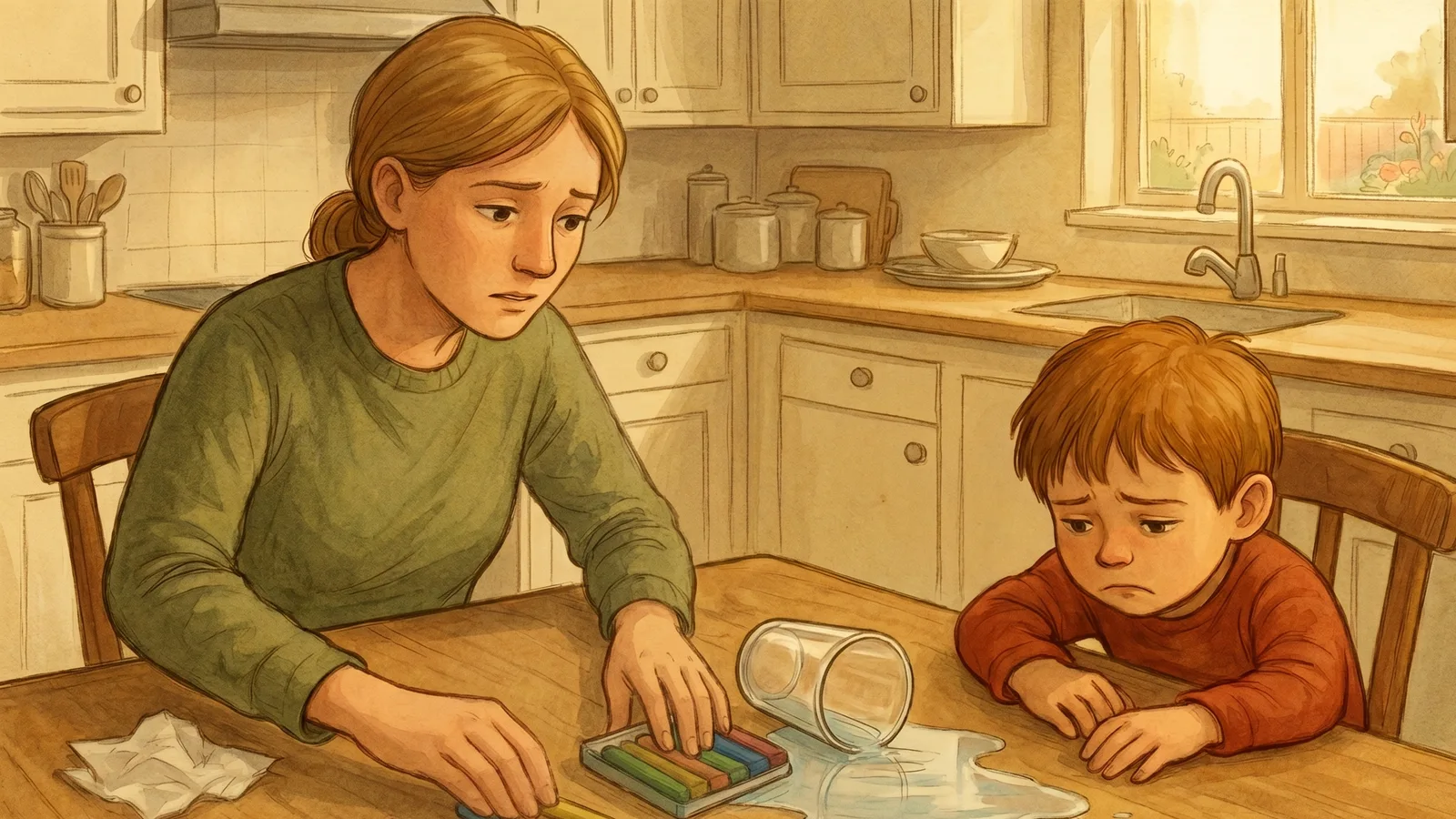
It is a home where children still protest and adults still lead. Where spills happen, tempers rise, limits disappoint, and evenings go sideways. But the deeper lesson is not that the strongest person wins by becoming the biggest feeling in the room. The deeper lesson is that firmness and connection do not have to cancel each other out.
What if that became one of the first things children learned about authority?
What if the adult's steadiness, including their ability to repair, became part of the structure itself?
What if the child did not have to choose between feeling the limit and feeling the relationship?
The Next Question Worth Staying With
For many adults, this idea brings relief and grief at the same time. Relief, because it names a different way of understanding why certain parenting moments feel so costly. Grief, because it can illuminate how often control has been confused with safety, effectiveness, or strength.
Still, there is something gentle in this reframe. It does not ask for perfect composure. It does not shame survival strategies that once made sense. It simply opens a more useful question about what happens inside us before behavior becomes the whole story.
And that may be the next place worth lingering.
Not just how to stop reactions, but what changes when those reactions are listened to closely enough to become information instead of command.
What to do next
Start with E.M.O.
Start with a guided nervous-system support experience.
Take the EFI
Get emotional clarity and identify your current regulation pattern.
1 on 1 Session
Work directly with guided support when you want faster progress.
