

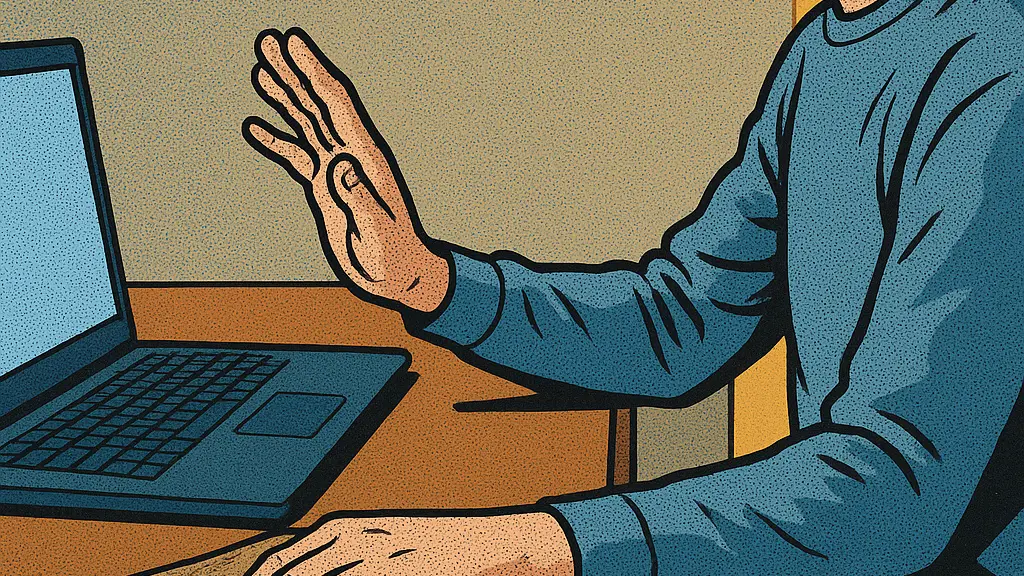
The Reaction Is Often Not the Whole Problem
Sometimes the hardest part is not the first reaction. It is the war that begins a second later.
A text comes in and feels colder than expected. Someone's face changes in the middle of a conversation. A sentence lands wrong and your chest tightens before you can explain why. The body reacts quickly. Heat rises. Breath shortens. Attention narrows. Then another voice arrives with its own command: not this, not again, get control, shut it down.
That second move changes the experience. What may have been a reaction becomes a problem you think you should not be having. The original flare is no longer just fear, hurt, anger, or alarm. Now it is also evidence, in your mind, that something is wrong with you for reacting at all.
This is why many emotionally aware people still feel trapped by their own responses. They are not only dealing with activation. They are dealing with the shame of activation.
Fighting the Feeling Often Feeds It
It makes sense that people try to overpower reactions. Most of us were trained to believe that maturity looks like immediate control. If the body surges, the responsible thing must be to suppress it, outthink it, or rise above it as fast as possible.
But reactions do not always quiet down when they are treated like enemies. Often they get louder.
Fear becomes shame about fear. Hurt becomes embarrassment about being hurt. Anger becomes panic about what anger might reveal. What started as a signal turns into a case against the self. The body is now carrying both the original reaction and the attack on the reaction.
That added layer matters. It increases pressure, confusion, and urgency. It can make a small moment feel much bigger than it would have if the system had not been forced into internal conflict.
The Present Moment Often Touches Something Older
One reason reactions can feel disproportionate is that they are rarely about the visible moment alone.
The present often brushes against something older before the mind has time to name it. A short reply may touch an old fear of dismissal. A change in tone may wake up helplessness you learned to hide. A misunderstanding may hit a part of you that still expects to be judged, exposed, or abandoned when your needs become visible.
This does not mean every reaction is accurate. It does not mean every feeling tells the truth about the other person. It means the intensity may be carrying more history than the surface event explains.
That is important because it changes the question. Instead of asking only, why am I like this, you can ask, what did this moment touch that already mattered before today?
Listening Is Not the Same as Obeying
This is where people often get nervous about the idea of listening to reactions. They assume listening means granting full authority to every feeling. If I listen, am I supposed to believe every fear, justify every anger, or organize my life around every surge?
No.
Listening is not obedience. Listening is inquiry.
It means becoming curious before becoming corrective. It means noticing the sequence clearly enough to separate the trigger from the interpretation and the interpretation from the self-attack that follows. It means asking a better set of questions while the reaction is still alive.
What got activated here? What feels threatened? What is this reaction trying to protect? What part of me feels suddenly exposed, unseen, cornered, or unsafe? Those questions do not flatten the reaction into truth. They stop you from flattening yourself into a problem.
The Inner Crackdown Creates a Second Injury
For many people, the most damaging part of a reaction is not the reaction itself. It is the inner crackdown that arrives immediately after it.
You feel the sting of a comment, then instantly shame yourself for being sensitive. You notice jealousy, then move straight into disgust that you could still be this insecure. You feel angry, then become afraid that the anger means you are immature, dangerous, or fundamentally unhealed.
Now the system is no longer handling one injury. It is handling two.
The first injury is the moment that landed. The second is the speed with which you turn against yourself for having a human response to it.
This second injury is easy to miss because it often sounds responsible, intelligent, or morally serious. It sounds like self-management. In reality, it can be a form of self-violence. It punishes the system for sending a signal before the signal has even been understood.
What Shadow Work Adds Without Taking Over the Piece
If you have read Jung or heard the language of shadow work, this is one place it can be quietly useful.
Sometimes what gets activated is not only pain. Sometimes it is contact with a disowned part of the self. Neediness, envy, anger, dependence, vulnerability, tenderness, even longing can all become shadow material when they conflict with the identity you work hard to maintain.
A reaction can therefore feel threatening not just because of what happened, but because of what it reveals. It may expose a part of you that does not match your self-image of being composed, generous, detached, strong, or beyond all that. When that happens, the reaction is often attacked with extra force. The system is trying to bury the part as much as regulate the feeling.
This is where shadow work fits. Not as a dramatic excavation. Not as an excuse to indulge every impulse. More as a quiet willingness to notice which human qualities you only tolerate in theory. The reaction may be showing you not only a wound, but a disowned part of your own range.
A Small Shift Changes the Whole Sequence
The useful shift is not to become endlessly absorbed in every feeling. It is to interrupt the automatic war.
A simple version sounds like this: something in me got activated, and now another part of me wants to attack the activation. That sentence does not solve the reaction, but it creates space. It keeps you from confusing the flare with the verdict.
Once that space exists, choice becomes possible. You may still decide the reaction is partly old. You may still realize you misread the moment. You may still need to regulate, repair, apologize, clarify, or step away. But you are doing it with more information and less internal brutality.
That difference matters. It keeps the system from hardening around shame. It reduces the odds that reaction becomes identity.
Why This Creates More Freedom, Not Less
People often fear that if they stop fighting reactions, they will become more reactive. In practice, the opposite is often closer to the truth.
What makes reactions sticky is not always the original trigger. Often it is the force used to make sure the trigger never matters again. The harder you push certain feelings underground, the more power they gain when they return. The more quickly you interpret activation as failure, the less able you become to stay present long enough to understand what is happening.
Listening changes that relationship. It does not guarantee calm. It does not produce immediate clarity. It does not remove the fact that some reactions are messy, inconvenient, or wrong about the moment. But it does reduce the extra suffering created by self-rejection.
And that is not a small improvement. It is often the beginning of emotional freedom.
Less self-violence means more room to tell the difference between what belongs to now and what was awakened from before. More room to notice when a disowned part has entered the room. More room to regulate without erasing yourself. More room to respond instead of simply obeying the loudest layer in the system.
If this lands, the next useful step is not to force a better reaction on command. It is to get better at noticing the early signs that your system has already started bracing, so you can meet the moment before the war inside you fully hardens.
What to do next
Start with E.M.O.
Start with a guided nervous-system support experience.
Take the EFI
Get emotional clarity and identify your current regulation pattern.
1 on 1 Session
Work directly with guided support when you want faster progress.
