

Regulating in Culture
8 min read
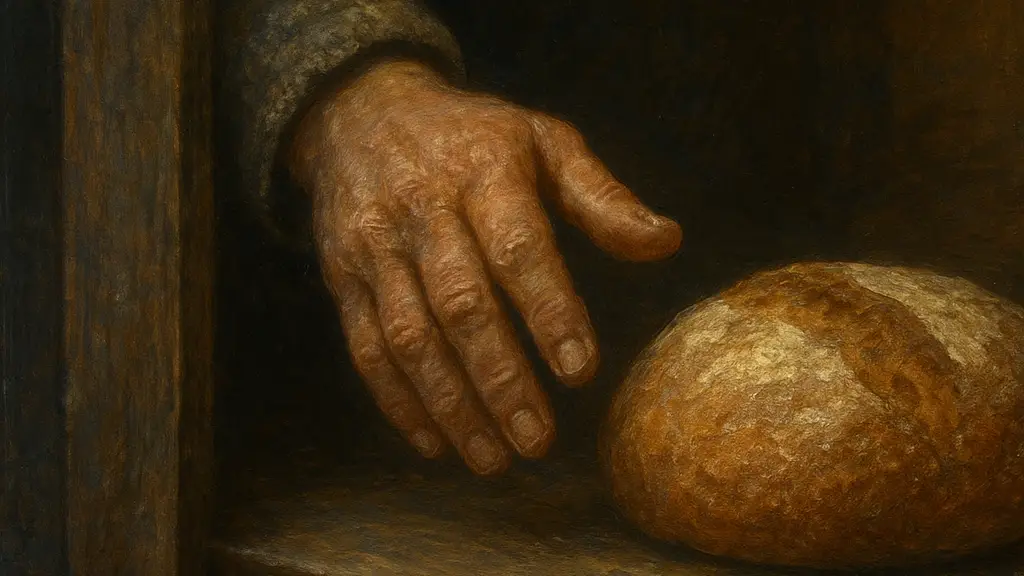
There is a reason the loaf gets remembered more easily than the seconds before it.
The Part People Usually Name First
The act is visible. The pressure is not.
In Les Miserables, Jean Valjean steals bread to feed his sister's starving children. That sentence is often treated as the whole event. A man takes what is not his. The moral frame arrives quickly. It sounds clean, almost self-contained.
But the moment is not clean from the inside.
He is not standing in ordinary discomfort. He is standing inside hunger that has become physical, immediate, and unresolved. Children are waiting. The body does not experience that as a philosophical question. It experiences it as strain, urgency, and narrowing. By the time the bread is taken, something important has already happened.
The visible choice is not the first thing that occurred.
The first thing is a tightening.
The Real Fork Happens Earlier
The bread is not the real fork.
The fork is the moment his system decides there is no other way.
That is what is easy to miss when people look only at action. We tend to assume a decision begins where we can see it. A hand moves. A voice rises. Money gets spent. A lie is told. A door closes. From the outside, that seems like the beginning because that is the first part available to judgment.
But inside the person, the beginning usually arrives sooner.
It arrives when the field of possibility starts to shrink. It arrives when waiting no longer feels livable, when asking seems pointless, when risk and shame and failure have already accumulated in the body. It arrives when several imperfect options stop feeling like options at all.
This does not turn every act into a good act. It does not erase consequences. It does not flatten real harm. It does something more useful than that. It makes the sequence more accurate.
And accuracy matters.
Because if the act is not the whole story, then moral certainty by itself is not enough to explain what happened.
What Pressure Does to a Human System
Under intense pressure, the nervous system does not conduct a spacious review.
It narrows.
Hunger narrows. Fear narrows. Repeated failure narrows. So does the knowledge that people depend on you and you have nothing left that seems workable. The body begins to privilege speed over reflection, relief over range, immediacy over nuance. Time changes character in those moments. It feels shorter, sharper, more absolute than it may actually be.
In a steadier state, a person might register several paths at once. Ask again. Wait one more hour. Endure the humiliation. Knock on another door. Risk being refused. Risk being seen. Risk not being helped.
Under survival pressure, those possibilities can dim almost all at once.
That is the part many people understand intuitively but cannot always name. The issue is not simply that the person chose badly. It is that the internal conditions of choosing had already been altered. Pressure had begun deciding what counted as real. What remains visible then is often the fastest route, the nearest relief, the move most likely to interrupt pain soonest.
From the outside, this can look impulsive.
From the inside, it can feel inevitable.
Why the Scene Lands So Hard
Part of what makes this bread scene endure is that it touches something people recognize beyond the story itself.
Not everyone knows hunger at that scale. Not everyone knows the pressure of trying to feed children with no lawful path available. Those material realities matter, and any serious reading has to leave room for them. Structural pressure is not background decoration. Poverty changes the shape of a moment long before anybody calls the final act a choice.
Still, even when the stakes are different, the pattern feels familiar.
Most people know what it is like for a moment to close too fast.
You are already overwhelmed, and one more demand arrives. A conversation starts turning, and your body hardens before your thoughts have caught up. You open your phone to handle one thing and suddenly feel cornered by five. Someone asks a question and your answer comes out with more force than you intended. Later, looking back, the action seems too simple to explain what it felt like while it was happening.
That mismatch matters.
The observer sees the move. The person inside the moment feels the closing.
Both are real. Only one tells the whole sequence.
An Ordinary Version of the Same Pattern
Imagine a late afternoon when you are already running behind. You have skipped lunch, your inbox is filling, and a message lands that sounds more demanding than it probably is. You feel your chest tighten before you even finish reading. Within seconds, the only option that feels available is to fire back, protect yourself, and end the discomfort quickly.
Nothing about that scene is theatrical. That is part of why it matters.
In calmer conditions, you might notice other possibilities. Ask for clarification. Wait ten minutes. Reply with one sentence instead of seven. Decide the message is irritating without deciding it is dangerous. But under pressure, the body often collapses those distinctions. Fast starts to feel necessary. Sharp starts to feel efficient. The action arrives carrying a force that was building before the words did.
Later, you might judge yourself for the reply.
But the more interesting question is what happened just before it.
The Moment Before "No Other Way"
This is the part worth studying with care.
There is often a brief period when the system shifts from strain into conviction. Not conviction in the moral sense. Conviction in the bodily sense. A closed feeling. A corridor feeling. A sense that there is only one live path left.
That moment can be easy to miss because it does not usually announce itself. It is felt more than argued. A tightening in the chest. A shortening of time. A hardening of attention. Less curiosity. Less tolerance for uncertainty. Less access to anything slow, relational, or subtle.
Then the mind starts organizing around that bodily state.
There is no point asking. There is no time to wait. This has to happen now. I already know how this ends. I need relief more than I need range.
Once the body is there, the act that follows can look strangely obvious. That is why people often confuse the final move for the whole story. They are seeing the last visible expression of a process that started deeper and earlier.
If the moment is read only at the level of behavior, the inner mechanics disappear. If the inner mechanics disappear, people keep trying to solve a narrowing problem with judgment alone.
Judgment has limits. It can describe an outcome. It cannot always explain how a moment became so small.
What Changes When the Closing Becomes Visible
The point of noticing this is not to excuse anything. It is to see where the moment actually turned.
When that turning point becomes visible, a more realistic kind of responsibility becomes possible. Not grand responsibility. Not total control. Just the kind that begins earlier.
A person may not be able to remove the pressure. Jean Valjean cannot think his way out of hunger, poverty, or the reality of children needing food. Many people cannot reason their way out of structural conditions that are already bearing down on the body. That should be said plainly.
But in many ordinary moments, recognizing the narrowing itself can matter.
Not because it produces perfect decisions. Because it sometimes prevents inevitability from hardening so fast.
A little more space is often enough to restore one additional option. Not five. Not endless freedom. Just one more real option than the system thought it had a second ago. That can be the difference between a sharp word and a slower sentence. Between an impulsive purchase and a pause. Between collapsing into self-judgment and noticing that your body is treating urgency like a command.
Sometimes the most meaningful shift is simply this: the next move stops feeling like the only move.
When the Story Stops Being About Morality Alone
This is why the bread scene stays alive in culture.
It is not only about right and wrong. It is about what pressure does before right and wrong get named. It is about the hidden part of a decision, the part where the body starts closing around necessity. Once you see that, the scene changes. Not into innocence. Not into sentimentality. Into clarity.
You begin to notice that many moments people call bad decisions are actually endings to a process of narrowing.
And once that becomes easier to see, another question naturally follows.
What happens when a stressed system starts calling everything urgent?
That is often the next place the pattern becomes visible in ordinary life, long before a moment fully closes and long before one path starts to feel like the only path left.
What I Left Out
I published this yesterday. I woke up this morning feeling I had left something out.
Not something small. Something that changes the shape of the whole thing.
I wrote about what pressure does to a person with no margin. The tightening. The narrowing. The moment Jean Valjean’s system decides there is no other way. I meant that. That narrowing is real. It explains more than judgment alone ever can.
But I woke up with a king in my chest.
Not Louis XVI as a historical figure. A body. A man with margin. Food on his table. Reports of hunger he learned to let pass through him without landing. I kept imagining him as a little prince the first time he heard about children starving in the countryside of land that he would one day rule. What happened in his tiny body then? Did something tighten? Did he feel the edge of a feeling his elders soon told him he could not afford to feel? And then, this is the part I kept circling, what did he do to make that feeling go away?
A few years ago, I sat in a meeting where someone proposed cutting a program that served families in crisis. The person making the proposal had never been hungry. They spoke in spreadsheets. But here is what I noticed: when someone else asked a direct question about what would happen to the families, the person’s voice got faster. They shifted to abstractions. Efficiencies. Streamlining. Tough choices. Their body had closed. Not because they were in danger. Because something had asked them to feel something they had already decided not to feel.
That was when the confusion turned into recognition.
Emotional regulation is not only what the desperate do to survive. It is also what the comfortable do to stay comfortable. The hungry narrow toward relief. The powerful narrow toward not seeing. Both are closings. Both happen in the body. But only one gets called a failure of character. The other gets called pragmatism, reasonableness, the way things have to be.
I wonder what that costs in the long run.
The king had to harden. He had to stop feeling. He had to let the suffering of others become acceptable so his own comfort could remain intact. Those were forks too. They just happened upstream, in bodies that were not desperate.
So yesterday’s piece was not wrong. It was partial.
I traced the narrowing of the hungry. I did not write about who built the system that made the hunger possible. Tell only one side, and the structure disappears. The king stays clean.
The loaf gets remembered.
But who built the bakery?
What to do next
Start with E.M.O.
Start with a guided nervous-system support experience.
Take the EFI
Get emotional clarity and identify your current regulation pattern.
1 on 1 Session
Work directly with guided support when you want faster progress.
