

Mentor’s Corner: Why We Get So Precise About Session Notes
Mentor’s Note: As part of my role mentoring practitioners who are completing the EFT Universe Clinical EFT certification process, I regularly receive thoughtful and nuanced questions about technique, safety, and application. From time to time, I turn those questions into written reflections so others can benefit from the conversation.
These posts are not only for mentees. If you are exploring EFT for yourself, you are welcome here. You will gain insight into how practitioners are trained to work with emotional intensity carefully, ethically, and effectively, and why precision matters in this work.
A question I hear often in mentoring is:
- Why so nitpicky about session notes?
- Do I really need to write my thoughts down the same day or next day?
- Do I have to come up with answers to all the fields in the template?
This is one of the most important questions in training, because it goes to the heart of clinical skill development.
First Clarification: Timing
This is not about same-day submission. It is about same-day or next-day memorialization.
You can submit later.
But if you do not write down your process while it is fresh, you will forget details that matter.
The longer you wait, the more likely it is that:
- sequence gets fuzzy
- SUD changes become estimates
- rationale gets reconstructed
- aspects blur together
That is normal memory drift, not failure. The structure exists to protect against it.
What You Are Actually Being Asked to Track
In Mentoring Module 1, the documentation standard is not random. The key pieces are clear:
- Track SUDs throughout the session.
- Work with specific events, not broad global material.
- For each issue you tap on, identify at least three aspects.
- Use testing as intensity comes down, including checks in the safe range as you move toward zero.
And aspects are not vague. You are usually tracking:
- sensory aspects
- emotions
- body sensations
So when mentors ask for precision, that is what we mean. We are asking for the clinical map, not extra prose.
Do You Have to Fill Every Field with Everything?
No.
Some sections will be brief. Some may not apply.
But in the top half of the template, before the Who, What, When, Where, and Why, it is wise to stretch yourself.
Those early fields are not busywork. They are prompts for deeper noticing.
If they feel hard to complete, that is often useful information. It may mean more specificity could have been elicited. Or that certain aspects were present but not fully named.
The goal is not perfection. The goal is sharpening perception.
A Useful Approach
You do not need to write books in every section. You do need to convey what you are trying to show.
A practical way to think about it:
- Pick two or three objectives you are showcasing.
- In targeted session details, describe the moments where those objectives were actually demonstrated.
- List techniques used.
- Give rationale for why you used them.
You do not have to convey everything. You do have to make your clinical reasoning visible.
Why This Feels Strict, and Why It Matters
Here is the part I want every mentee to hear clearly:
This documentation is for two people:
- your present mentor
- your future self
The more important one is your future self.
You have to concretize your thinking. Slow it down. Make explicit what is implicit.
You need to be able to break your process down so that if something does not work, you can identify where, identify why, and adjust accordingly.
That skill is the point.
In certification, conditions are more controlled. There is support, lower pressure, and room to practice.
Later, with real paying clients who expect meaningful results, you will not have extra time to build that troubleshooting skill from scratch.
You need to build it now.
And that starts with clearly writing down what happened in your mind and in the session.
A Practical Way to Fill Notes Without Overwhelm
If notes are taking too long, use this sequence:
Write a quick skeleton same day or next day.
- target event
- key aspects
- SUD arc
- major techniques used
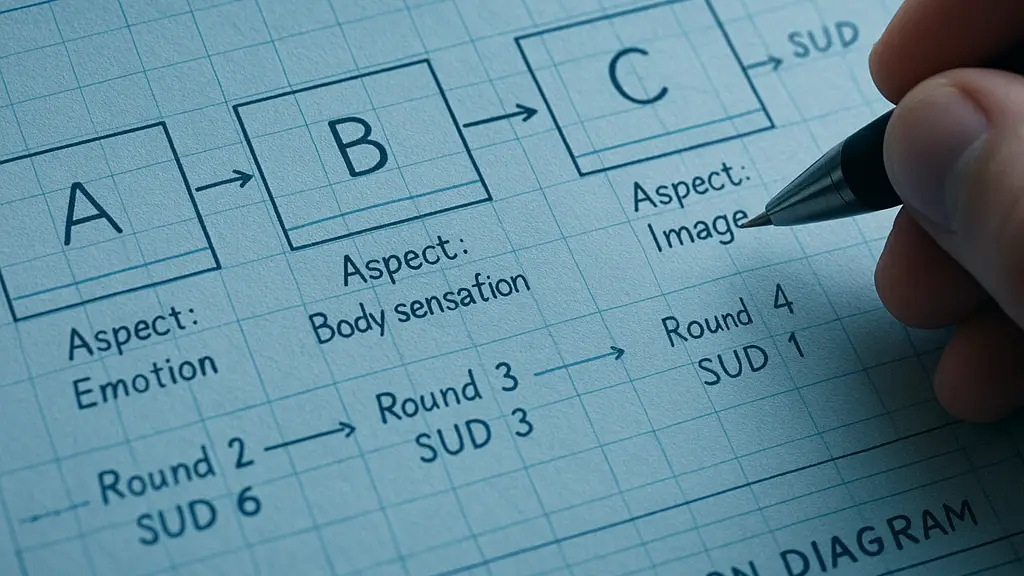
In targeted details, show sequence.
- A to B to C to D
- what shifted
- what did not
- what you changed in response
Pull only the techniques you actually used. Copy and paste from the template list. Add rationale for each.
Keep quality high, not word count high.
- specific over verbose
- clear over polished
- traceable over perfect
If a field does not apply, mark it clearly and move on. If you forgot something, name that directly in the write-up.
The Hidden Gain
Many trainees think notes are for evaluation. Mostly, notes are for calibration.
Good notes train you to:
- spot pattern drift early
- detect weak decisions without shame
- improve between sessions, not just after outcomes fail
- stay grounded when complexity rises
That is why mentors sound precise. Not to control you, but to prepare you.
Closing Reflection
If this has felt nitpicky, I understand.
Try this reframe:
This is not about proving you did a session. It is about building a practitioner mind that can stay clear under pressure.
Write your notes so future you can trust your own process.
That is the standard.
What to do next
Support options
Recommended next step
Take the EFI
Get emotional clarity and identify your current regulation pattern.
Take the EFIStart with E.M.O.
Start with a guided nervous-system support experience.
Talk to E.M.O.1 on 1 Session
Work directly with guided support when you want faster progress.
Book a session