

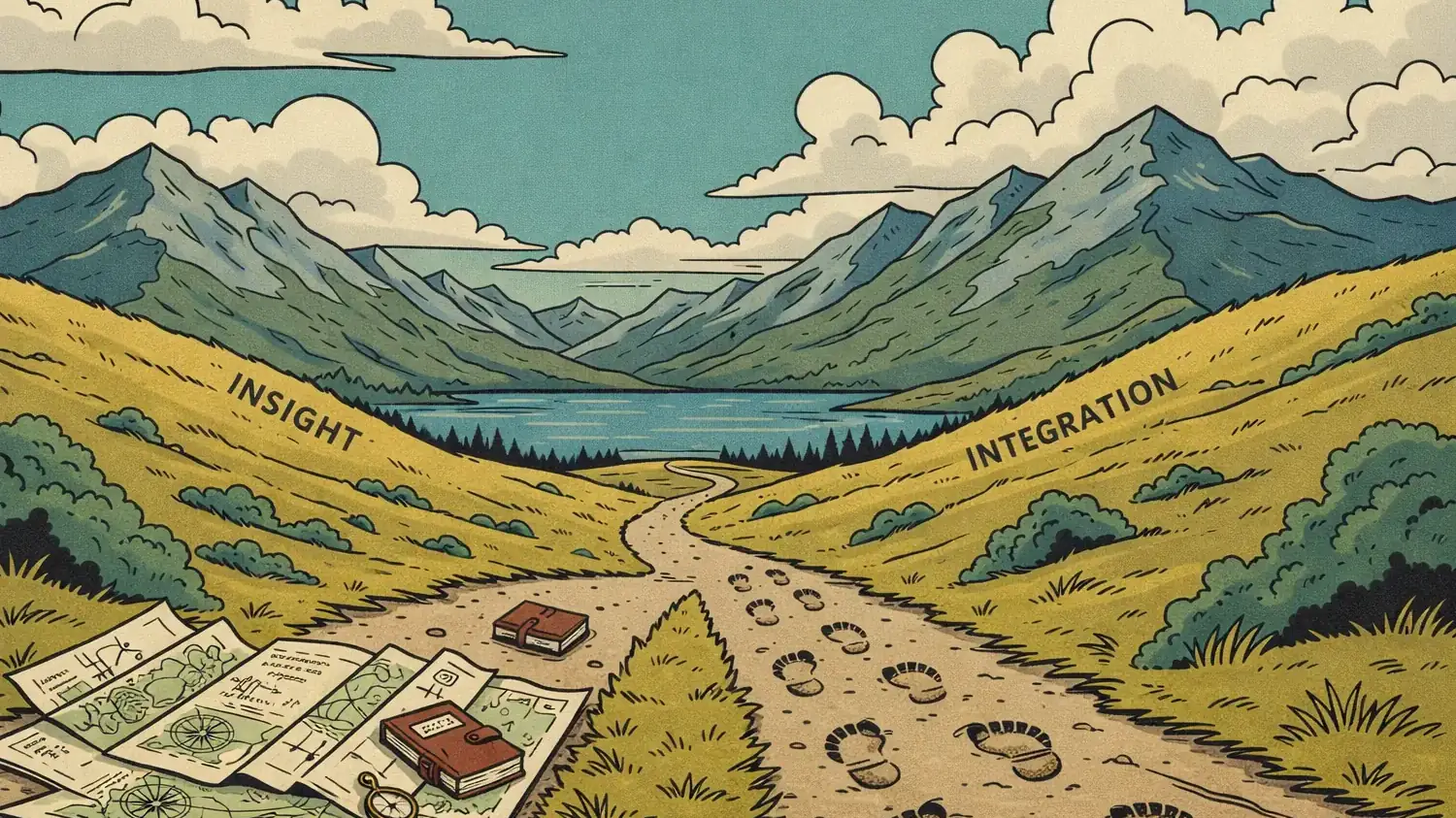
Why Insight Isn't the Same as Integration
You can understand your patterns and still repeat them.
You might know exactly where a reaction began. You can trace it back through family dynamics, past relationships, moments of embarrassment or loss. You can name your attachment style. You can explain why criticism makes your chest tighten or why silence from someone you care about pulls you into overanalysis. You have language for all of it.
And yet, there you are again. In the middle of a conversation, feeling the familiar shift. Your shoulders lift. Your breath shortens. Your tone changes before you fully register it. Later, you can describe the whole sequence with precision. In the moment, it still takes over.
That gap is disorienting. Especially for someone who has done the work.
You may have spent years in therapy. You have read the books. You have listened to the podcasts. You have reflected, journaled, examined your history from multiple angles. You are not confused about yourself. In many ways, you are more self-aware than most people around you.
Which makes the repetition harder to tolerate.
A quiet thought can start to form. If I understand this so clearly, why am I still doing it? Maybe I just lack discipline. Maybe I am not trying hard enough. Maybe I should be further along by now.
That interpretation feels logical. It also misses something important.
Insight operates primarily in calm states. It lives in the after. After the conversation ends. After your body settles. After you have space to think. In those moments, your reflective mind is online. You can observe, analyze, contextualize. You can even feel compassion for yourself.
Activation is different.
When pressure rises, your nervous system prioritizes protection. It does not consult your latest realization. It moves toward what has worked before, even if what worked before is now costly. A sharp response might have once protected your dignity. Withdrawal might have once protected your heart. Overexplaining might have once protected your belonging.
Those responses are not character flaws. They are learned survival strategies.
Insight helps you understand them. Integration changes how automatically they fire.
That change rarely happens through understanding alone. It happens through repetition while the charge is present. Through practicing a different response in the same conditions where the old one used to take over.
This is where many thoughtful, emotionally literate adults plateau.
You can see the pattern as it unfolds. You might even catch it earlier than you used to. But seeing is not the same as steering. You are aware of the reflex and still feel it move through you. The old pathway remains more automatic than the new one you are trying to build.
It can feel like being split in two. One part of you knows better. Another part reacts first.
Nothing is wrong with you.
You are encountering the limits of insight as a primary tool.
Understanding is cognitive. Integration is physiological. The nervous system changes through experience, not explanation. It recalibrates through repeated exposure to activation paired with a different outcome.
That process is slower and more embodied than analysis. It asks for practice inside discomfort. Not dramatic confrontation, but tolerable stretches. Staying with a rising sensation for three breaths. Allowing silence without filling it. Speaking one clear sentence instead of five defensive ones. Letting your face soften when your instinct is to harden.
These are small things. They are also rewiring events.
When done alone, they can be difficult to sustain. Not because you are incapable, but because the moment of activation is precisely when your self-observing capacity narrows. The very state in which you need the new response is the state that reduces access to it.
This is often where the assumption of self-sufficiency quietly strains.
You might believe that because you understand the pattern, you should be able to retrain it by yourself. And sometimes you can. Daily repetition, structured exercises, and consistent reflection do create change. Many people benefit from tools that help them practice outside high-stakes moments, building baseline regulation and capacity.
But if you notice that you keep circling the same relational or emotional edge, despite years of awareness, it may not be a matter of willpower. It may be that integration requires a training environment.
Not rescue. Not fixing. Training.
In a structured 1 on 1 setting, the goal is not to explain you to yourself. You have already done that. The work is to slow down activation as it happens, to feel it in the body, and to practice a different response while supported. The presence of another regulated nervous system changes what is possible. It creates conditions where you can stay with sensations that would otherwise tip you into reflex.
Over time, those rehearsed responses become less effortful. The body begins to recognize that disagreement does not equal danger. That vulnerability does not equal collapse. That uncertainty does not require immediate control.
This is not a rejection of insight. It is a maturation of it.
Insight brought you clarity. It likely reduced shame and helped you understand your history with nuance. Integration builds on that foundation. It turns knowledge into muscle memory.
If you still feel foggy about your patterns, tools like EFI can help you clarify what is actually repeating. If you want daily repetition and nervous system conditioning in smaller doses, E.M.O. offers structured practice you can return to consistently.
And if you sense that you have extracted most of what insight alone can offer, and you are ready to practice new responses where they actually matter, then exploring 1 on 1 support may be a reasonable next step.
Not because you failed. Not because you need rescue.
Because training often works better in partnership.
If you are ready to integrate what you already understand, explore 1 on 1 support.
What to do next
Continue Reading
The Real Process of Emotional Change (From Trigger to Capacity)
Support options
Recommended next step
Take the EFI
Get emotional clarity and identify your current regulation pattern.
Take the EFIStart with E.M.O.
Start with a guided nervous-system support experience.
Talk to E.M.O.1 on 1 Session
Work directly with guided support when you want faster progress.
Book a session